
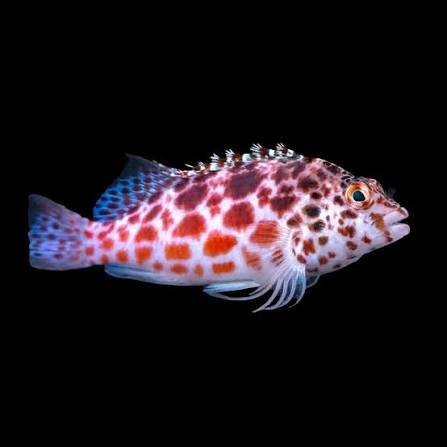
| Parameter | Value |
|---|---|
| Diet | Carnivore |
| dKH | 8-12 |
| Maximum Size | 10 cm (3.9 in) |
| Minimum Tank Size | 20 gallons (76 L) |
| pH | 8.1-8.4 |
| Temperament | Semi-aggressive |
| Temperature | 72-82 F (22-28 C) |
| Weight | Approximately 8 g (0.3 oz) |
The Pixy/Spotted Hawkfish (Cirrhitichthys oxycephalus), also known as the Coral Hawkfish or Sharp-headed Hawkfish, is a species of marine ray-finned fish belonging to the family Cirrhitidae. It is native to tropical reefs of the Indian Ocean and the Pacific Ocean.
Distribution and Habitat
The Pixy/Spotted Hawkfish has a wide distribution in the Indian and Pacific Oceans. They occur from the Red Sea south along the coast of East Africa as far south as South Africa and east across the Indian Ocean into the Pacific Ocean to the Marquesas Islands south to Australia and north to Japan. They live in areas of dense coral growth and in the clear waters of lagoon, channel or outer reefs at depths down to at least 40 meters.
Physical Description
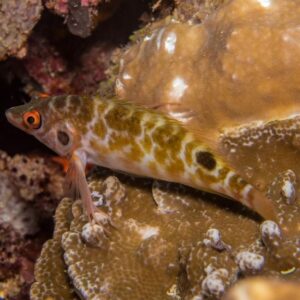
The Pixy/Spotted Hawkfish has a maximum recorded total length of 10 cm (3.9 in). It has an oval moderately compressed body with a pointed snout. This is a variably coloured species, the background colour varying from whitish to pink marked with reddish-brown to greyish or bright reddish-orange blotches.
Diet and Feeding
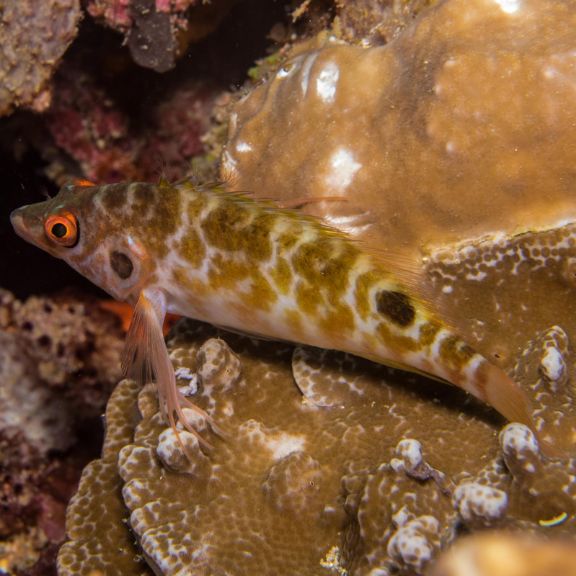
The Pixy/Spotted Hawkfish is normally observed perching on top of soft corals and sponges. It ambushes crustaceans and small fishes that pass its station. In captivity it accepts brine shrimp, mysis shrimp, and prepared foods.
Behavior and Reproduction
Like other hawkfishes the adult does not have a swimbladder and they hop from perch to perch. The males are territorial and guard harems of females. This species is a protogynous hermaphrodite. They are pelagic spawners and the spawning pair ascends into the water column.
Aquarium Care
It requires a tank of at least 20 gallons with plenty of live rock and coral for perching. It is semi-aggressive and should be kept with similarly sized or larger tankmates. It may eat small shrimp and should not be housed with very small peaceful species.
Conservation Status
Classified as Least Concern by the IUCN Red List.
Reviews
There are no reviews yet.