
| Parameter | Value |
|---|---|
| Diet | Carnivore |
| dKH | 8-12 |
| Maximum Size | 9 cm (3.5 in) |
| Minimum Tank Size | 20 gallons (76 L) |
| pH | 8.1-8.4 |
| Temperament | Semi-aggressive |
| Temperature | 72-82 F (22-28 C) |
| Weight | Approximately 10 g (0.4 oz) |
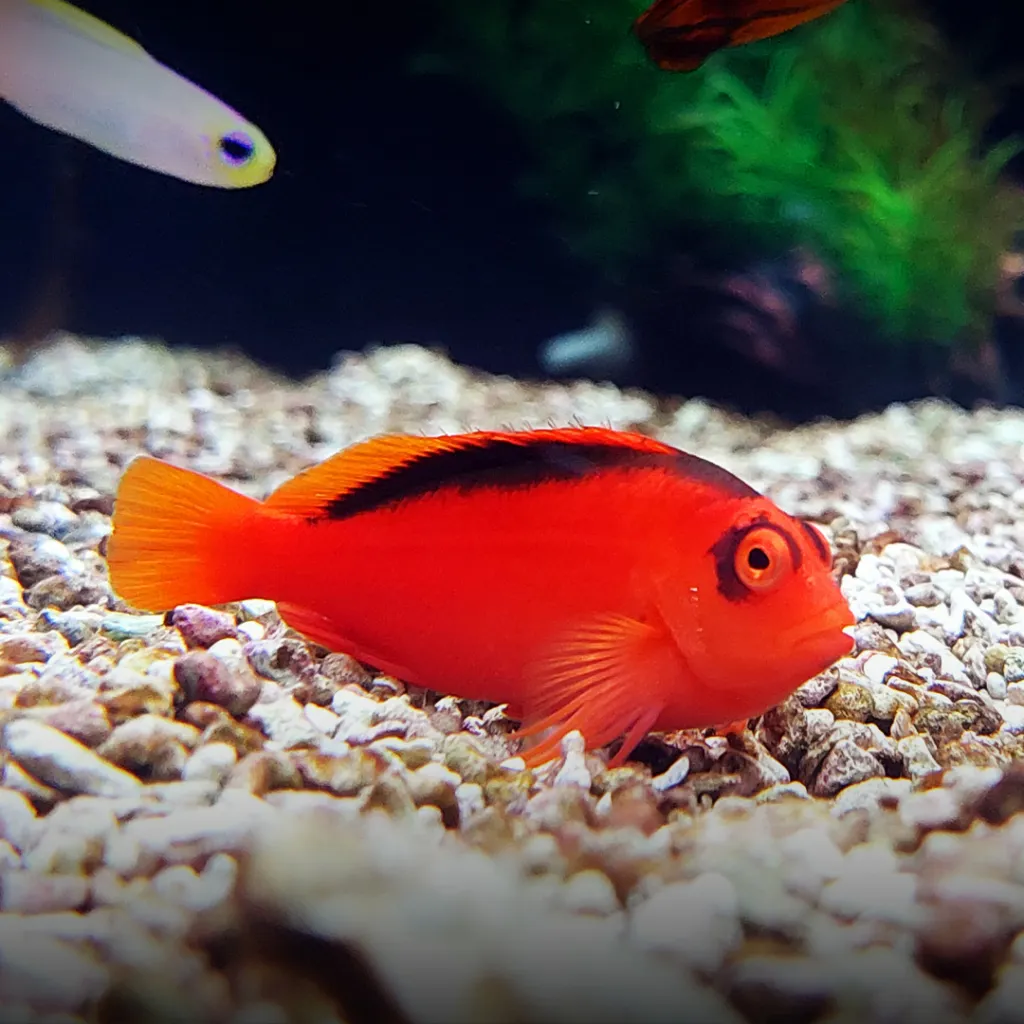
The Flame Hawkfish (Neocirrhites armatus) is a species of marine ray-finned fish, a hawkfish belonging to the family Cirrhitidae. It is native to tropical reefs of the Pacific Ocean.
Distribution and Habitat
The Flame Hawkfish is found in the western Pacific where its range extends as far north as the Ryukyu and Ogasawara Islands of Japan across the Pacific as far as the Pitcairn Islands and south to the Great Barrier Reef off Queensland. It may be found as deep as 25 meters but is more commonly encountered between 10 and 15 meters. It is a common species on reef fronts with exposure to tidal surge and on underwater terraces.
Physical Description
The Flame Hawkfish reaches a maximum total length of 9 cm (3.5 in). It has a very deep highly compressed body. This species is bright red with areas of black around the eyes and beneath the dorsal fin. The dorsal fin spines are short with a tassel of cirri at the tip of each spine.
Diet and Feeding
The Flame Hawkfish feeds on small crustaceans. It is typically observed using the branches of live corals to hide among while waiting for prey. In captivity it accepts brine shrimp, mysis shrimp, and prepared foods.
Behavior and Reproduction
The Flame Hawkfish is typically observed perching on coral heads. It is an oviparous pelagic spawner which breeds in monogamous pairs. The adults do not have a swim bladder and use their robust pelvic fins as supports when perching on corals.
Aquarium Care
It requires a tank of at least 20 gallons with plenty of live rock and coral heads for perching. It is semi-aggressive and should be kept with similarly sized or larger tankmates. It may eat small shrimp and should not be housed with very small peaceful species. It is one of the more popular species of hawkfish for the hobby aquarium.
Conservation Status
Classified as Least Concern by the IUCN Red List.
Reviews
There are no reviews yet.