
| Parameter | Value |
|---|---|
| Diet | Herbivore |
| dKH | 8-12 |
| Maximum Size | 22 cm (8.7 in) |
| Minimum Tank Size | 125 gallons (473 L) |
| pH | 8.1-8.4 |
| Temperament | Semi-aggressive |
| Temperature | 72-82 F (22-28 C) |
| Weight | Approximately 300 g (0.7 lbs) at maximum size |
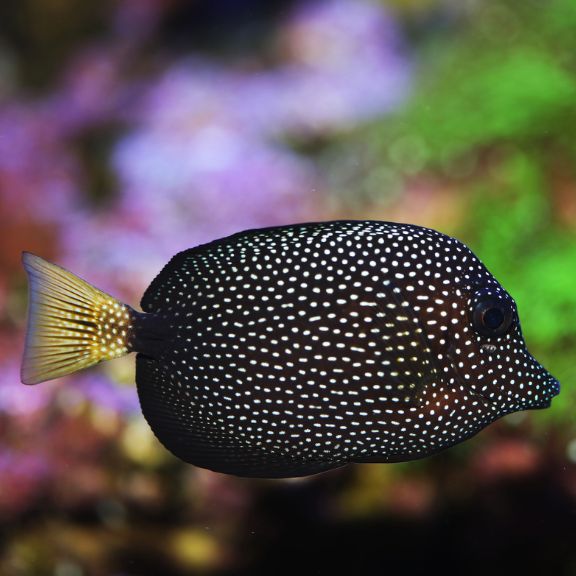
The Gem Tang (Zebrasoma gemmatum), also known as the jewelled tang, spotted tang, or Mauritian tang, is a species of marine ray-finned fish belonging to the family Acanthuridae. It was first formally described as Acanthurus gemmatus in 1835 by the French zoologist Achille Valenciennes. The specific name gemmatum means ‘jewelled’, presumed to be an allusion to the many spots on the body. The spotted tang is a highly prized specimen by marine aquarists and often commands high prices.
Physical Description
The Gem Tang has its dorsal fin supported by 4 spines and 27 or 28 soft rays while its anal fin is supported by 3 spines and 24 or 25 soft rays. The body is deep, its depth fitting into the standard length 1.6 to 1.9 times. The snout is of medium length with a concave dorsal profile. The high dorsal fin has a longest ray which would fit into the standard length between 2.6 and 3.2 times. The overall colour is dark brown with a large number of small white spots, typically round but some may be stretched lengthways, on the head body, anal fin and dorsal fin. The caudal fin is yellow. The maximum published total length is 22 cm (8.7 in).
Distribution and Habitat
The Gem Tang is endemic to the southwestern Indian Ocean. It has been recorded from South Africa between Kosi Bay and the Eastern Cape, Mozambique, Madagascar, the French Southern Territories in the Mozambique Channel, Reunion and Mauritius. This is a rare, territorial species typically found singly on coral reefs in deeper waters down to around 60 m, typically deeper than 25 m.
Aquarium Care
The Gem Tang is highly prized in the aquarium trade and reaches high prices. It requires a well-established aquarium of at least 125 gallons with stable water conditions and abundant live rock. It is semi-aggressive and may display territorial behavior toward other tangs. Generally considered reef-safe.
Conservation Status
Classified as Data Deficient by the IUCN Red List as very little is known about its biology or how the harvest for the aquarium trade affects the population.
Reviews
There are no reviews yet.