
| Parameter | Value |
|---|---|
| Diet | Herbivore |
| dKH | 8-12 |
| Maximum Size | 24 cm (9.4 in) |
| Minimum Tank Size | 180 gallons (681 L) |
| pH | 8.1-8.4 |
| Temperament | Semi-aggressive |
| Temperature | 74-82 F (23-28 C) |
| Weight | Approximately 400 g (0.9 lbs) at maximum size |
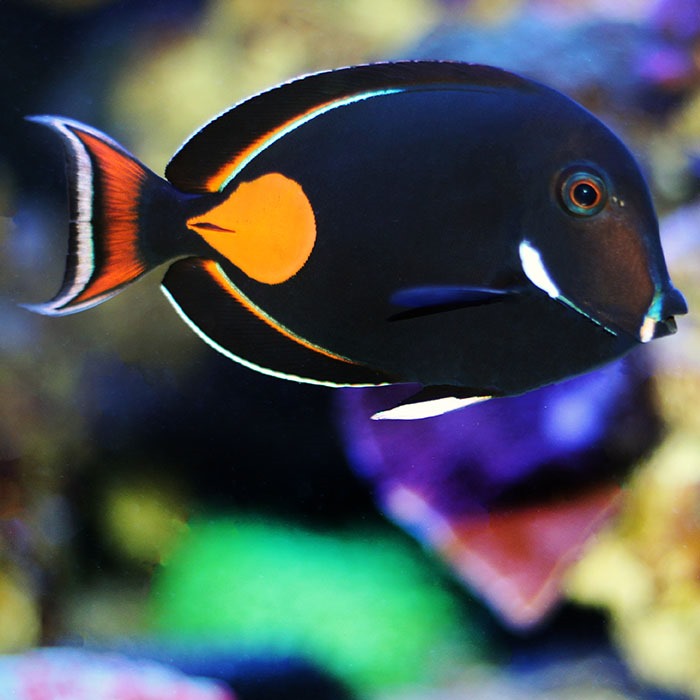
The Achilles Tang (Acanthurus achilles), also known as the redtail surgeonfish or redspot surgeonfish, is a marine ray-finned fish in the family Acanthuridae. It was first formally described in 1803 by the English biologist George Shaw. The specific name achilles is thought to refer to the mythical Greek hero Achilles, alluding to the sharp bony plates on the caudal peduncle.
Physical Description
The Achilles Tang has an elongated oval-shaped body with a steep dorsal profile to the head. The dorsal fin is supported by 9 spines and between 29 and 33 soft rays while the anal fin contains 3 spines and 26 to 29 soft rays. The overall color is bluish-black with an irregular oval orange blotch near the rear of the body and a white bar on the operculum. The caudal fin is predominantly orange with a white posterior margin. There is a pale blue ring around the snout tip. This species reaches a maximum total length of 24 cm (9.4 in).
Distribution and Habitat
The Achilles Tang is found in various reefs of Oceania, up to the islands of Hawaii and Pitcairn. It is also found in the Mariana Islands and some reefs in southern Mexico and Guatemala. It is a benthopelagic species which inhabits the clear waters on the seaward side of reefs.
Diet and Feeding
The Achilles Tang is herbivorous, grazing largely on benthic algae. It is territorial and monogamous.
Aquarium Care
The Achilles Tang is considered one of the more difficult tangs to keep in captivity. It requires a large, well-established aquarium with excellent water quality and high oxygen levels. It is semi-aggressive and may display territorial behavior toward other tangs. Provide abundant live rock for grazing and hiding. Not considered reef-safe as it may nip at some corals.
Conservation Status
Classified as Least Concern by the IUCN Red List.
Reviews
There are no reviews yet.