
| Parameter | Value |
|---|---|
| Diet | Omnivore |
| dKH | 8-12 |
| Maximum Size | 45 cm (17.7 in) |
| Minimum Tank Size | 200 gallons (757 L) |
| pH | 8.1-8.4 |
| Temperament | Semi-aggressive |
| Temperature | 72-82 F (22-28 C) |
| Weight | Approximately 1,100 g (2.4 lbs) at maximum size |
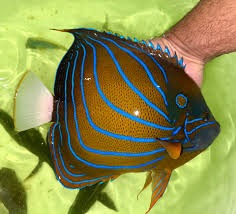
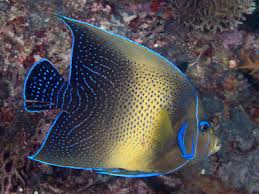
The Annularis Angelfish (Pomacanthus annularis), also known as the Bluering Angelfish or Blue King Angelfish, is a species of marine angelfish belonging to the family Pomacanthidae. It was first formally described in 1787 by the German physician and naturalist Marcus Elieser Bloch. The specific name annularis means ‘ringed,’ referring to the distinctive blue ring-shaped mark on the body above the gill cover. The Annularis Angelfish
Distribution and Habitat
is found in the Indo-West Pacific, from East Africa throughout Indonesia and New Guinea to New Caledonia, and north to southern Japan. It inhabits coastal rocky coral reefs and may also be encountered in caves or on wrecks at depths ranging from 3 to 30 meters.
Physical Description
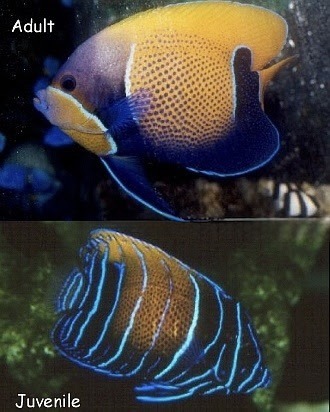
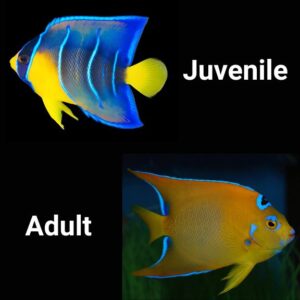
Adults are predominantly yellow with striking arcing blue lines across the body and a distinctive blue circle-shaped mark above the operculum. They frequently have an elongated tip to the dorsal fin and a white caudal fin with a yellow margin. Juveniles display a bluish-black overall coloration with thin white to blue curved lines. The dorsal fin has 13 spines and 20-21 soft rays while the anal fin contains 3 spines and 20 soft rays. This species reaches a maximum total length of 45 cm (17.7 in). Adults
Diet and Feeding
feed mainly on zooplankton, sponges, filamentous algae, and tunicates. Juveniles prefer very shallow waters and consume large quantities of filamentous algae.
Behavior and Reproduction
They are protogynous hermaphrodites, living in harems with the male defending a territory. Due to its large adult size,
Aquarium Care
the Annularis Angelfish requires a spacious aquarium of at least 200 gallons with abundant live rock. It is semi-aggressive and not considered reef-safe.
Conservation Status
Classified as Least Concern by the IUCN Red List.
Reviews
There are no reviews yet.