
| Parameter | Value |
|---|---|
| Diet | Omnivore |
| dKH | 8-12 |
| Maximum Size | 45 cm (18 in) |
| Minimum Tank Size | 200 gallons (757 L) |
| pH | 8.1-8.4 |
| Temperament | Semi-aggressive |
| Temperature | 72-82 F (22-28 C) |
| Weight | Approximately 1,600 g (3.5 lbs) at maximum size |
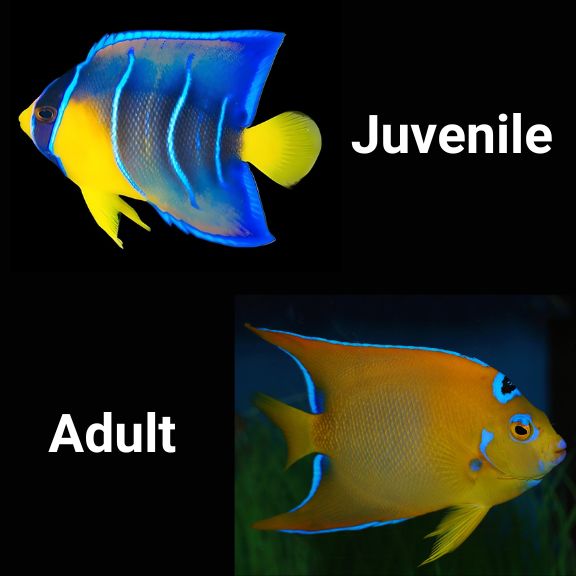
The Queen Angelfish (Holacanthus ciliaris), also known as the Blue Angelfish, Golden Angelfish, or Yellow Angelfish, is a species of marine angelfish found in the western Atlantic Ocean. It was first described in 1758 by Carl Linnaeus. It is a benthic warm-water species that lives in coral reefs. It is recognized by its blue and yellow coloration and a distinctive spot or ‘crown’ on its forehead, which distinguishes it from the closely related Bermuda blue angelfish (Holacanthus bermudensis), with which it overlaps in range and can interbreed. The Queen Angelfish
Physical Description
has a broad, flattened, oval-shaped body with triangular tail fin, a reduced, dulled snout and a small mouth. The dorsal and anal fins both dangle behind the body. This species attains a maximum total length of 45 cm (18 in) and weight of 1,600 g. Males may be larger than females. Juveniles are dark blue with bright blue vertical stripes and a yellow pectoral area. Queen angelfish are found in tropical and subtropical areas of the Western Atlantic Ocean from Florida along the Gulf of Mexico and the Caribbean Sea down to Brazil. They are benthic and occur from shallow waters close to shore down to 70 meters. They live in coral reefs, preferring soft corals, and swim either alone or in pairs. Queen angelfish eat sponges, tunicates, jellyfish, corals, plankton, and algae. Juveniles act as cleaner fish and establish cleaning stations. Male queen angelfish have large territories with a
Behavior and Reproduction
harem of two to four females. They are presumed to be protogynous hermaphrodites. Spawning occurs year-round, observed around a full moon. The Queen Angelfish
Aquarium Care
is popular in the aquarium trade. It requires a spacious aquarium of at least 200 gallons with stable water conditions. Not considered reef-safe.
Conservation Status
Classified as Least Concern by the IUCN Red List.
Reviews
There are no reviews yet.