
| Parameter | Value |
|---|---|
| Diet | Omnivore |
| dKH | 8-12 |
| Maximum Size | 15 cm (5.9 in) |
| Minimum Tank Size | 55 gallons (208 L) |
| pH | 8.1-8.4 |
| Temperament | Peaceful |
| Temperature | 72-82 F (22-28 C) |
| Weight | Approximately 60 g (2.1 oz) at maximum size |
The Watanabei Angelfish (Genicanthus watanabei), also known as the Blackedged Angelfish or Watanabe’s Angelfish, is a species of marine angelfish belonging to the family Pomacanthidae. It was first formally described in 1970 by the Japanese ichthyologists Fujio Yasuda and Yoshiaki Tominaga. The specific name honours the Japanese ichthyologist Masao Watanabe. The Watanabei Angelfish
Physical Description
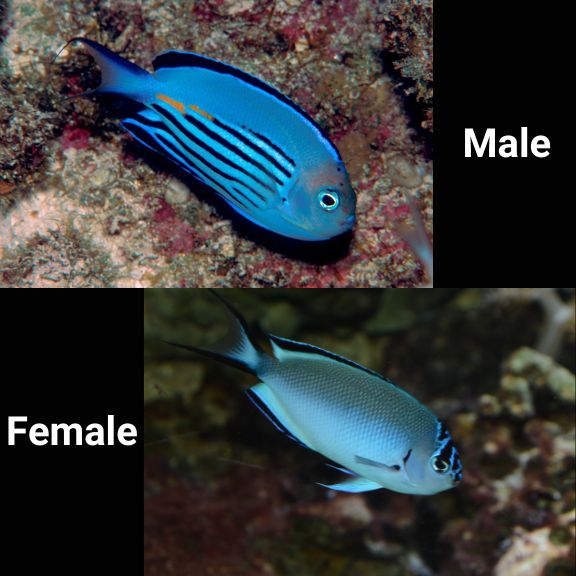
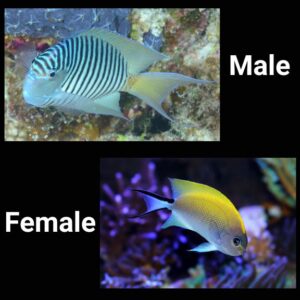
shows sexual dichromatism. Males are pale blue to bluish-grey on the upper third of their bodies with the lower two thirds having 8 horizontal, thin black stripes, the highest of which ends in a patch of yellow. Females are overall light blue with wide black bars across their head and a black spot on the snout. In both males and females there is a wide submarginal band on the dorsal and anal fins, and on the lobes of the caudal fin. In both sexes the forked tail narrows at its base to create a swallow tail. The dorsal fin contains 15-16 spines and 15-16 soft rays while the anal fin has 3 spines and 14-17 soft rays. This species attains a maximum total length of 15 cm (5.9 in). The Watanabei Angelfish
Distribution and Habitat
is found in the Pacific Ocean. It ranges from Taiwan east to the Cook Islands and Tuamotu Archipelago, north to the Ryukyu Islands and south to New Caledonia and the Austral Islands. It also occurs on the Great Barrier Reef. It occurs at depths between 12 and 81 meters on the outward slopes of reefs and on drop-offs where there is a strong current. It
Diet and Feeding
feeds on plankton in the water column. Like all of their congeners, the Watanabei Angelfish
Behavior and Reproduction
is a protogynous hermaphrodite. They have a lek mating system where large males control territories and females move freely between them. Unlike most angelfish, Genicanthus species are generally considered more reef-safe due to their plankton-based diet. They are peaceful and can be kept with a variety of tankmates.
Conservation Status
Classified as Least Concern by the IUCN Red List.

Reviews
There are no reviews yet.