
| Parameter | Value |
|---|---|
| Diet | Carnivore |
| dKH | 8-12 |
| Maximum Size | 13 cm (5.1 in) |
| Minimum Tank Size | 30 gallons (114 L) |
| pH | 8.1-8.4 |
| Temperament | Semi-aggressive |
| Temperature | 72-82 F (22-28 C) |
| Weight | Approximately 15 g (0.5 oz) |
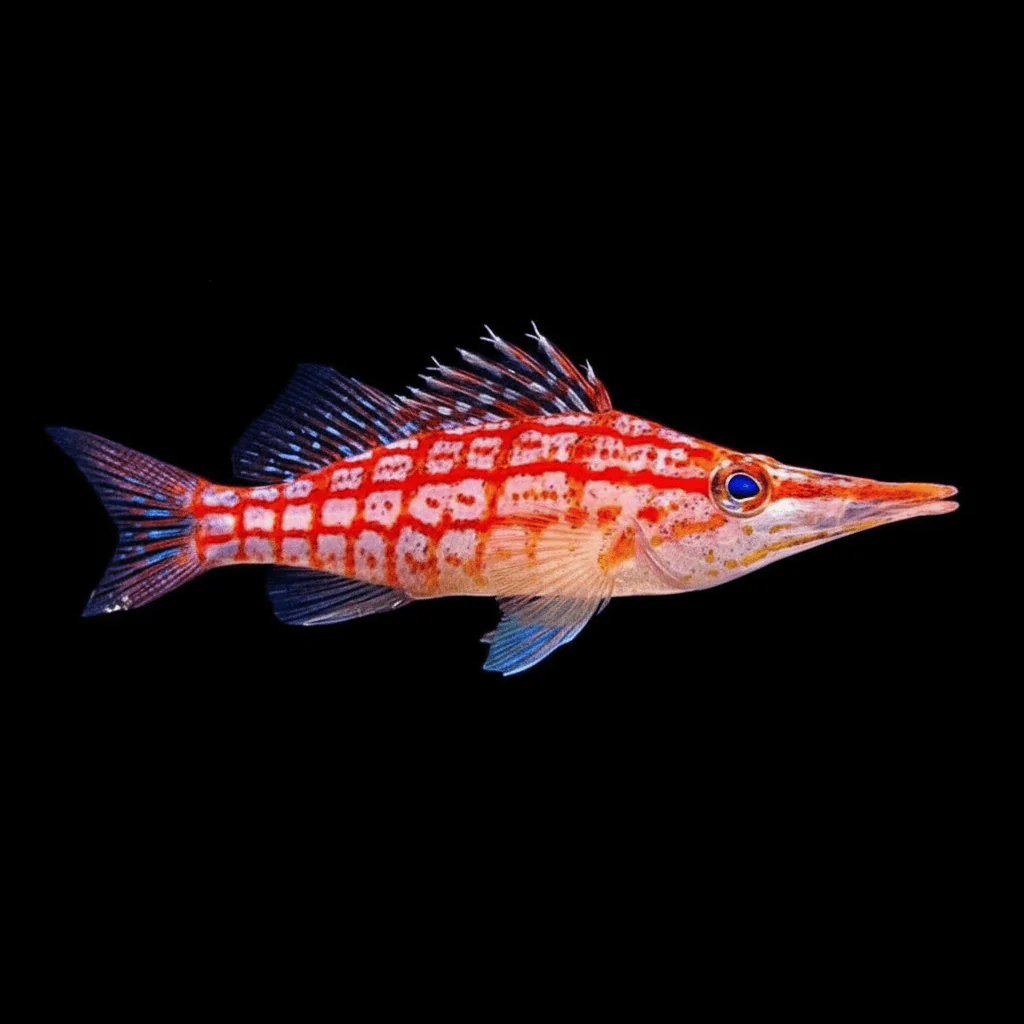
The Longnose Hawkfish (Oxycirrhites typus) is a species of marine ray-finned fish, a hawkfish belonging to the family Cirrhitidae. It is found on tropical reefs of the Indian Ocean and the Pacific Ocean.
Distribution and Habitat
The Longnose Hawkfish has a wide Indo-Pacific distribution. In the Indian Ocean it is found from the Red Sea along the coast of east Africa south to northern Mozambique and Madagascar across the Indian Ocean into the Pacific where it reaches as far east as the Hawaiian Islands and French Polynesia north to Japan and south to Australia. It occurs at depths between 10 and 100 meters. It is found on steep outer reef slopes which are exposed to strong currents, living among large gorgonians and black corals.
Physical Description
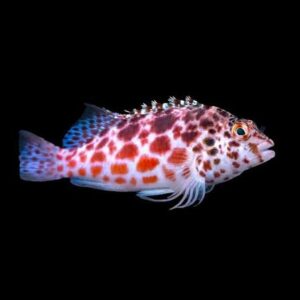
The Longnose Hawkfish reaches a maximum total length of 13 cm (5.1 in). It differs from all other hawkfish species in its elongated snout, the length of the snout fitting roughly twice into the overall length of the head. The overall colour of the body is whitish overlain with a grid of red horizontal and vertical lines. There is a tuft of cirri at the tip of each dorsal fin spine.
Diet and Feeding
The Longnose Hawkfish preys on small benthic or planktonic crustaceans. In captivity it accepts brine shrimp, mysis shrimp, and prepared foods.
Behavior and Reproduction
It is uncommon to rare in most of its range and it is a territorial species. They are pelagic spawners which form distinct monogamous pairs to breed.
Aquarium Care
It requires a tank of at least 30 gallons with plenty of live rock and gorgonians for perching. It is semi-aggressive and should be kept with similarly sized or larger tankmates. It may eat small shrimp and should not be housed with very small peaceful species. It is common in the aquarium trade.
Conservation Status
Classified as Least Concern by the IUCN Red List.
Reviews
There are no reviews yet.