
| Parameter | Value |
|---|---|
| Scientific Name | Urobatis sp. |
| Conservation Status | Least Concern |
| Diet | Carnivore |
| Maximum Size | 25 cm |
| Temperament | Semi-aggressive |
| Reef Safe | No |
| Origin | Eastern Pacific |
| Temperature | 59-72°F |
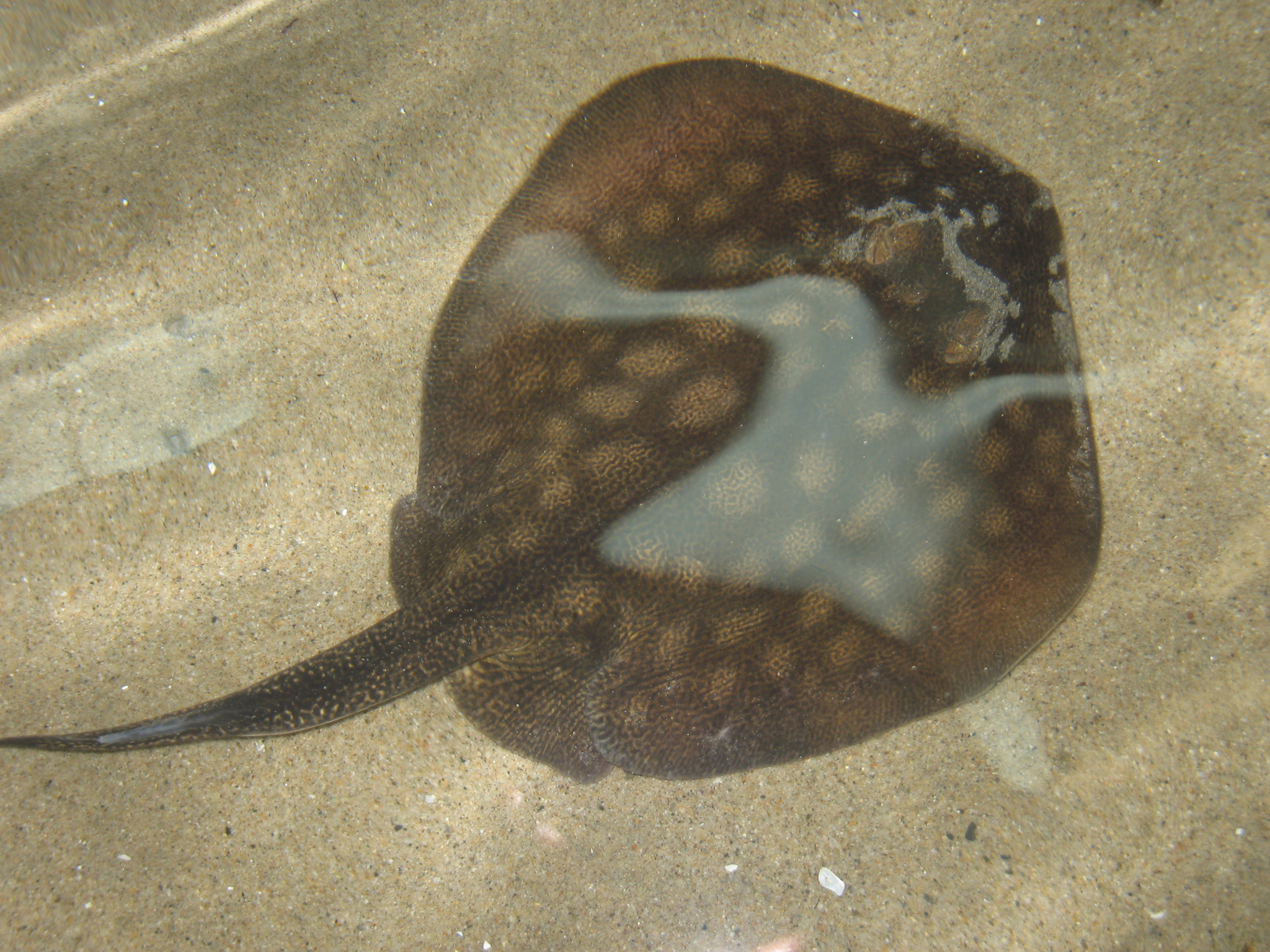
The Round Stingray (Urobatis sp.), frequently represented by the California round stingray (Urobatis halleri), is a small benthic batoid belonging to the family Urotrygonidae. Abundant in nearshore marine habitats along the eastern Pacific coastline, this species is noted for its compact circular disc, mottled camouflage, and active bottom-foraging habits.
Distribution and Habitat
The Round Stingray is native to the coastal waters of the eastern Pacific Ocean, ranging from northern California (Humboldt Bay) southward through Baja California, the Gulf of California, and Central America to Panama. It thrives in shallow, sheltered marine environments including sandy surf beaches, muddy estuaries, coastal bays, and tranquil kelp beds, typically residing from the intertidal zone to depths of 90 meters.
Physical Description
The Round Stingray features an almost circular pectoral disc measuring up to 25 cm (10 inches) in width, with a maximum total body length reaching approximately 58 cm. Its dorsal surface exhibits a greyish-brown to olive background with intricate yellowish spots, reticulated patterns, and dusky markings that blend seamlessly into sandy seafloors. The tail is sturdy, shorter than the disc, and lacks a dorsal fin, ending in a well-developed rounded caudal fin. A prominent serrated venomous barb is situated along the dorsal midline of the tail. The ventral underside is pale white or creamy yellow.
Diet and Feeding
A carnivorous benthic generalist, the Round Stingray feeds on infaunal and epifaunal invertebrates such as small crabs, amphipods, ghost shrimp, marine worms, bivalves, and small demersal fishes. It employs hydraulic jetting from its mouth and rhythmic undulations of its pectoral margins to excavate burrowed organisms from sand or mud. In captivity, it readily accepts thawed mysis shrimp, chopped squid, krill, fresh clam meat, earthworms, and diced silversides.
Behavior and Reproduction
The Round Stingray spends a large portion of the day buried beneath a thin layer of sand with only its eyes and spiracles visible to ambush prey and evade predators. It exhibits aplacental viviparity (ovoviviparity), where the mother nourishes embryos internally with uterine fluid (histotroph). Females produce litters of one to six pups following a gestation period of approximately three months, giving birth in warm, protected coastal lagoons during late summer and autumn.
Aquarium Care
In an aquarium setting, the Round Stingray requires a system of at least 150 to 200 gallons featuring a generous footprint and rounded corners. A generous layer of fine, sugar-soft sand is mandatory to allow natural burrowing and avoid abrasive ventral sores. Stable temperate water conditions between 59-72°F (15-22°C), high dissolved oxygen, and powerful filtration are critical. Because it relentlessly sifts the substrate and consumes motile invertebrates, it is not suitable for reef tanks containing ornamental shrimp or delicate sessile organisms.
Conservation Status
Classified as Least Concern by the IUCN Red List. Populations are healthy and abundant throughout its eastern Pacific range, with no significant threats endangering its wild stock.

Reviews
There are no reviews yet.