
| Parameter | Value |
|---|---|
| Scientific Name | Taeniura lymma |
| Conservation Status | Near Threatened |
| Diet | Carnivore |
| Maximum Size | 70 cm |
| Temperament | Semi-aggressive |
| Reef Safe | No |
| Origin | Indo-Pacific |
| Temperature | 72-78°F |
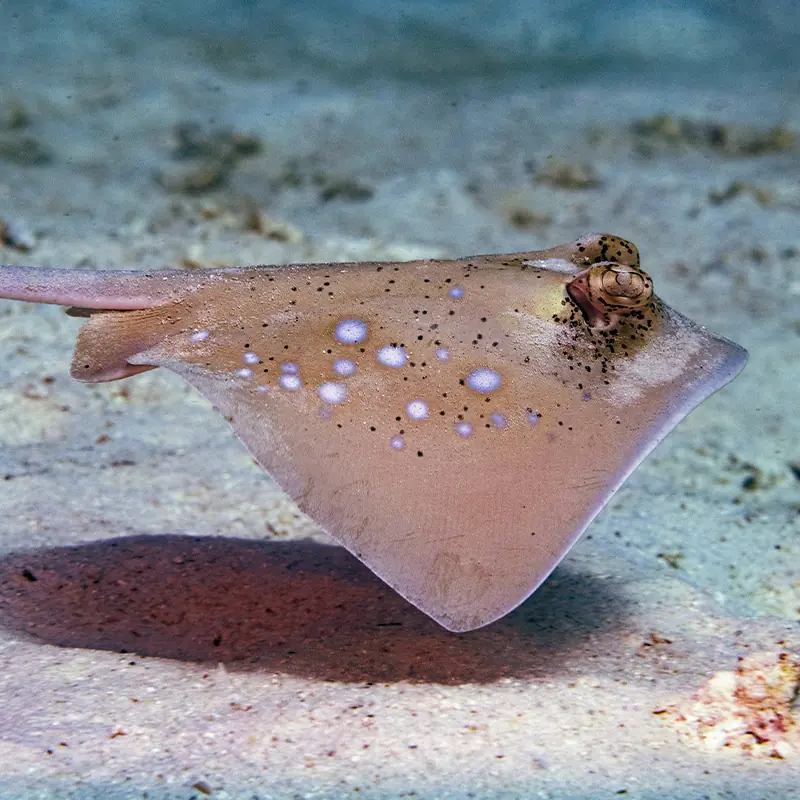
The Bluespotted Stingray (Taeniura lymma), also commonly known as the Bluespotted Ribbontail Ray, is a small and vibrantly colored whiptail stingray belonging to the family Dasyatidae. Renowned for its striking neon markings and graceful swimming posture, this species is a hallmark inhabitant of shallow tropical coral reefs across the Indo-Pacific region.
Distribution and Habitat
The Bluespotted Stingray is widely distributed across the tropical Indo-West Pacific, extending from the Red Sea and East Africa across Madagascar, India, Southeast Asia, northern Australia, and the Solomon Islands. It frequents shallow coastal coral reefs, sandy lagoons, seagrass flats, and reef crests at depths ranging from 1 to 30 meters. During low tide, it often seeks refuge under coral heads, rock overhangs, or inside reef caves.
Physical Description
The Bluespotted Stingray attains a disc width of roughly 35 cm (14 inches) and a maximum total length of 70 cm (28 inches). It possesses a smooth, oval-shaped pectoral disc that is slightly longer than it is wide. The dorsal coloration ranges from bright yellow-green to bronze or reddish-brown, decorated with an array of vivid electric-blue spots of varying sizes. Two vibrant blue longitudinal stripes run down the length of its thick, tapering tail. The tail features a broad lower fin fold and carries one or two serrated venomous stings near its midpoint.
Diet and Feeding
This species is a dedicated bottom-dwelling carnivore that feeds predominantly on small mollusks, polychaete worms, shrimps, crabs, and small benthic fishes. When the tide rises, it migrates across sand flats and coral rubbles, blowing jets of water into the sand to expose burrowed prey. In the aquarium, it requires a diverse diet of fresh or frozen meaty marine foods, including chopped clam, mysis shrimp, squid, pieces of fresh scallop, and small feeder fish.
Behavior and Reproduction
The Bluespotted Stingray is primarily solitary or encountered in small groups during high tide feeding forays. When resting or threatened, it frequently buries itself in soft substrate, leaving only its elevated golden-ringed eyes and spiracles exposed. Reproduction occurs through ovoviviparity with histotrophy, in which the female provides nourishing uterine milk to her developing young. Litters typically consist of one to seven pups born after a gestation period lasting up to twelve months.
Aquarium Care
Maintaining the Bluespotted Stingray in captivity requires an advanced setup of at least 200 to 300 gallons with an exceptionally wide footprint. The tank bottom must be blanketed in a thick layer of fine, smooth aragonite sand, as rough gravel or sharp rocks can quickly cause lethal bacterial infections on its sensitive underbelly. Excellent water quality, robust protein skimming, stable tropical temperatures between 72-78°F, and secure tank covers are essential. It is not reef safe and cannot be housed with ornamental crustaceans.
Conservation Status
Classified as Near Threatened by the IUCN Red List. The species faces ongoing population declines caused by widespread coral reef degradation, destructive fishing methods, and extensive harvesting for the ornamental aquarium hobby and artisanal coastal fisheries.

Reviews
There are no reviews yet.