
| Parameter | Value |
|---|---|
| Diet | Omnivore |
| dKH | 8-12 |
| Maximum Size | 20 cm (7.9 in) |
| Minimum Tank Size | 70 gallons (265 L) |
| pH | 8.1-8.4 |
| Temperament | Peaceful |
| Temperature | 72-82 F (22-28 C) |
| Weight | Approximately 120 g (4.2 oz) at maximum size |
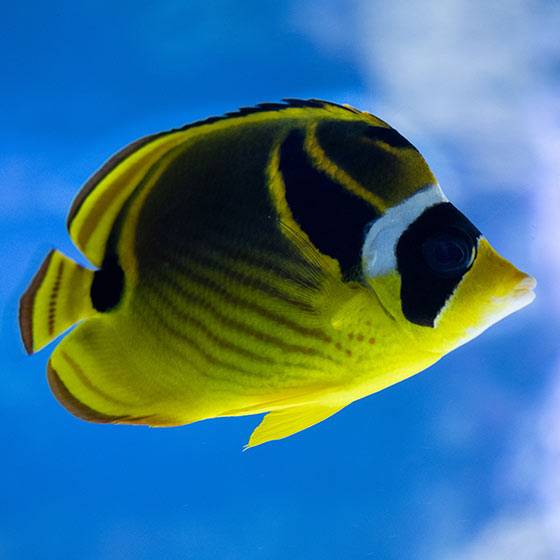
The Raccoon Butterflyfish (Chaetodon lunula), also known as the Crescent-masked Butterflyfish, Lunule Butterflyfish, or Halfmoon Butterflyfish, is a species of marine ray-finned fish belonging to the family Chaetodontidae. It is found in the Indian and Pacific Oceans.
Distribution and Habitat
The Raccoon Butterflyfish is found widely throughout the tropical Indo-Pacific region from East Africa to the Hawaiian and Marquesan islands, north to southern Japan. It is also found in the southeast Atlantic off South Africa. It prefers seaward reefs and shallow reef flats of lagoons at depths of over 30 meters.
Physical Description
The Raccoon Butterflyfish can reach a length of 20 cm (nearly 8 in). These large butterflyfishes have an oval outline with a pattern of ascending oblique reddish stripes on the flanks and black and white bands over the face and eyes, similar to a raccoon mask. They show a black spot on the caudal peduncle and oblique yellow stripes behind the head. They have 10-14 dorsal spines and 3 anal spines.
Diet and Feeding
The Raccoon Butterflyfish is a nocturnal species that feeds mainly on nudibranchs and small invertebrates, but also on algae and coral polyps. In captivity, it accepts a varied diet including mysis shrimp, brine shrimp, frozen preparations, and marine algae. It has been observed as a beneficial predator of Aiptasia and Majano sea anemones.
Behavior and Reproduction
This species is nocturnal and usually lives in small groups. It is an oviparous species that forms pairs for breeding.
Aquarium Care
The Raccoon Butterflyfish is generally not aggressive towards other fish, with the exception of lionfish and triggerfish. In captivity, the typical lifespan is five to seven years. It requires a tank of at least 70 gallons with stable water conditions. It may nip at soft corals, so caution is advised in reef tanks. It is prone to marine ich in confined environments.
Conservation Status
Classified as Least Concern by the IUCN Red List.

Reviews
There are no reviews yet.