
| Parameter | Value |
|---|---|
| Diet | Carnivore |
| dKH | 8-12 |
| Maximum Size | 19 cm (7.5 in) |
| Minimum Tank Size | 55 gallons (208 L) |
| pH | 8.1-8.4 |
| Temperament | Peaceful |
| Temperature | 72-82 F (22-28 C) |
| Weight | Approximately 100 g (3.5 oz) at maximum size |
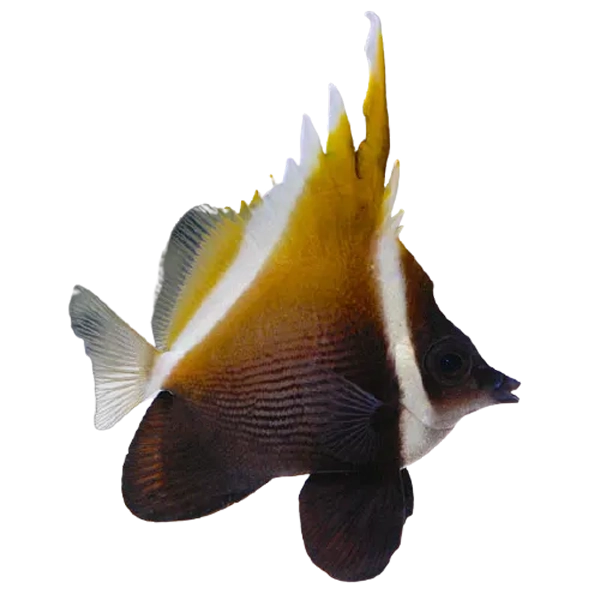
The Heniochus Butterflyfish (Heniochus varius), also known as the Horned Bannerfish or Humphead Bannerfish, is a species of marine ray-finned fish belonging to the family Chaetodontidae. It is native to the central Indo-Pacific area.
Distribution and Habitat
The Heniochus Butterflyfish is widespread throughout the tropical and subtropical waters of the central Indo-Pacific from Indonesia to Polynesia and from south Japan to New Caledonia. It inhabits areas rich in coral in shallow lagoons and external reef slopes from the surface to a depth of 30 meters.
Physical Description
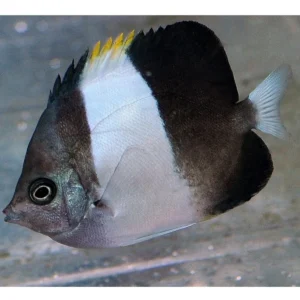
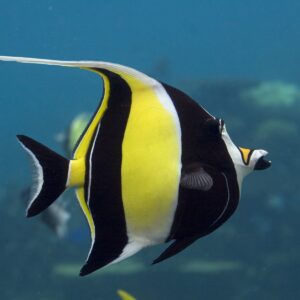
The Heniochus Butterflyfish can reach a maximum length of 19 cm (7.5 in). It has the typical deep-bodied and highly compressed body of butterflyfishes. The adults have a pair of obvious horns on the forehead just above the eyes and a prominent bump on the forehead. The predominant colour on the body is brown to blackish broken by a thin white band behind the head and a second running from the spiny part of the dorsal fin to the caudal peduncle. The two white stripes create a triangle of the base colour on the body. The dorsal fin has 11 spines and 22-25 soft rays while the anal fin contains 3 spines and 17-18 soft rays.
Diet and Feeding
The Heniochus Butterflyfish has a varied diet consisting of coral polyps and various benthic invertebrates. In captivity, it should be offered a varied diet including mysis shrimp, brine shrimp, and frozen preparations.
Behavior and Reproduction
The Heniochus Butterflyfish is a solitary fish but can live in pairs or even in small groups. It is an oviparous species.
Aquarium Care
The Heniochus Butterflyfish requires a tank of at least 55 gallons with stable water conditions and abundant live rock. It is generally peaceful and can be kept with a variety of tankmates. It may nip at corals, so it is not considered reef-safe.
Conservation Status
Classified as Least Concern by the IUCN Red List.
Reviews
There are no reviews yet.