
| Parameter | Value |
|---|---|
| Diet | Omnivore |
| dKH | 8-12 |
| Maximum Size | 20 cm (7.9 in) |
| Minimum Tank Size | 70 gallons (265 L) |
| pH | 8.1-8.4 |
| Temperament | Semi-aggressive |
| Temperature | 72-82 F (22-28 C) |
| Weight | Approximately 120 g (4.2 oz) at maximum size |
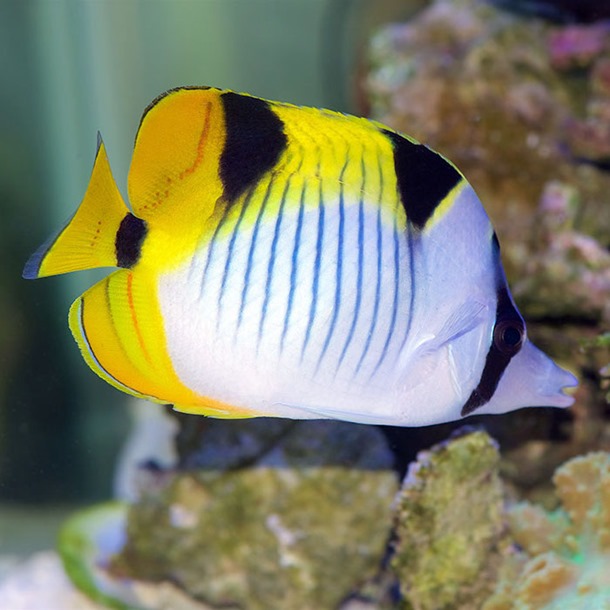
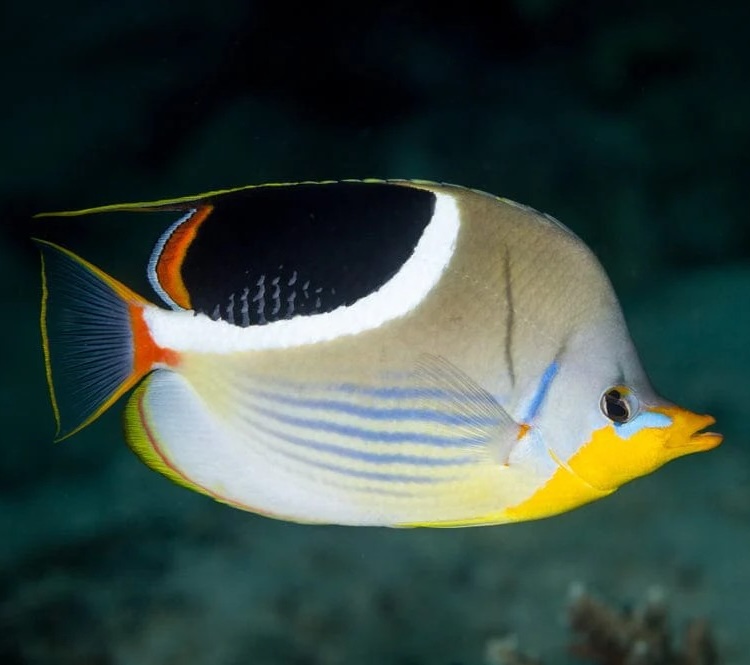
The Falcula Butterflyfish (Chaetodon falcula), also known as the Blackwedged Butterflyfish, is a species of marine ray-finned fish belonging to the family Chaetodontidae. It is found in the Indian Ocean.
Distribution and Habitat
The Falcula Butterflyfish is found in the Indian Ocean along the East African coast between Kenya and South Africa, Madagascar and other western and central islands of the Indian Ocean, Sri Lanka, southern India, the Andaman and Nicobar Islands, and from western Thailand east to Java. It occurs at depths of 1 to 15 meters on the reef edge and upper slope, normally in habitats subjected to strong currents.
Physical Description
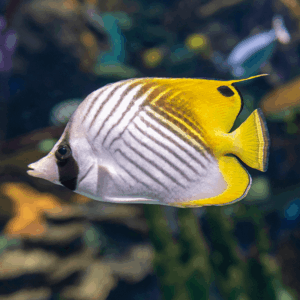
The Falcula Butterflyfish has a white body marked with thin vertical dark grey lines. It has two clear black saddle-like blotches on the dorsal part of the body, a vertical black eye band, and a black caudal peduncle. The dorsal, anal and caudal fins are yellow. The yellow continues onto the body adjacent to the dorsal and anal fins. There are 12-13 spines in the dorsal fin and 23-25 soft rays while the anal fin contains 3 spines and 20-21 soft rays. This species attains a total length of 20 cm (7.9 in).
Diet and Feeding
The Falcula Butterflyfish feeds on coral polyps, worms, sea anemones, crustaceans, sponges, the feet of sea urchins, and other invertebrates. In captivity, it should be offered a varied diet including mysis shrimp, brine shrimp, and marine algae.
Behavior and Reproduction
This species is typically seen in pairs or small aggregations of up to 20 fish. It forms distinct pairs to breed and the pelagic eggs are scattered in open water.
Aquarium Care
The Falcula Butterflyfish requires a tank of at least 70 gallons with stable water conditions and abundant live rock. It is semi-aggressive and may display territorial behavior toward similar-looking species. It may nip at corals, so it is not considered reef-safe. Multiple small feedings per day are recommended.
Conservation Status
Classified as Least Concern by the IUCN Red List.
Reviews
There are no reviews yet.