
| Parameter | Value |
|---|---|
| Diet | Omnivore |
| dKH | 8-12 |
| Maximum Size | 15 cm (5.9 in) |
| Minimum Tank Size | 50 gallons (189 L) |
| pH | 8.1-8.4 |
| Temperament | Peaceful |
| Temperature | 74-80 F (23-27 C) |
| Weight | Approximately 60 g (2.1 oz) at maximum size |
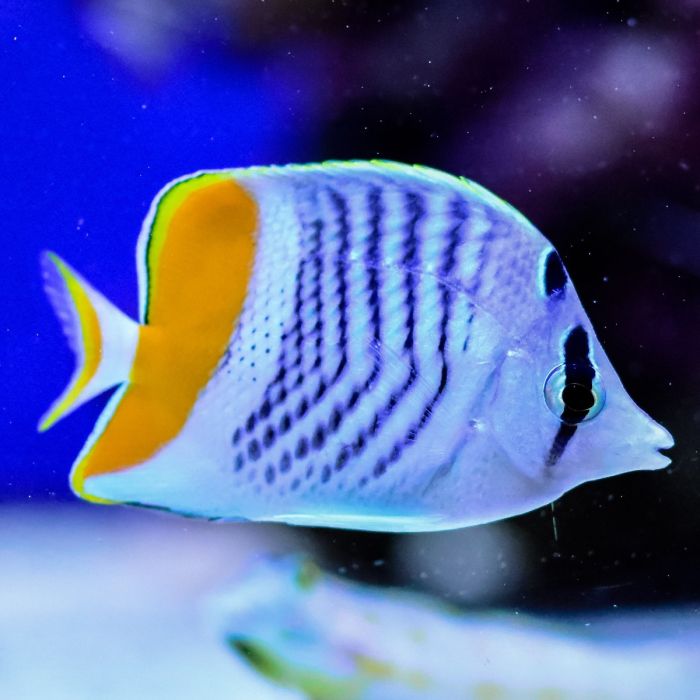
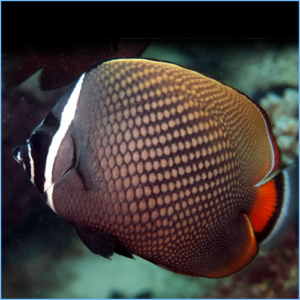
The Pearlscale Butterflyfish (Chaetodon xanthurus), also known as the Yellow-tailed Butterflyfish, Crosshatch Butterflyfish, or Philippines Chevron Butterflyfish, is a species of marine ray-finned fish belonging to the family Chaetodontidae.
Distribution and Habitat
The Pearlscale Butterflyfish is found on or around the reefs of the central Indo-Pacific region from Indonesia and the Philippines north to the Ryukyu Islands. It is a diurnal species usually found at depths below 6 meters in clear coastal to outer reef slopes and drop-offs, often around Acropora staghorn corals.
Physical Description
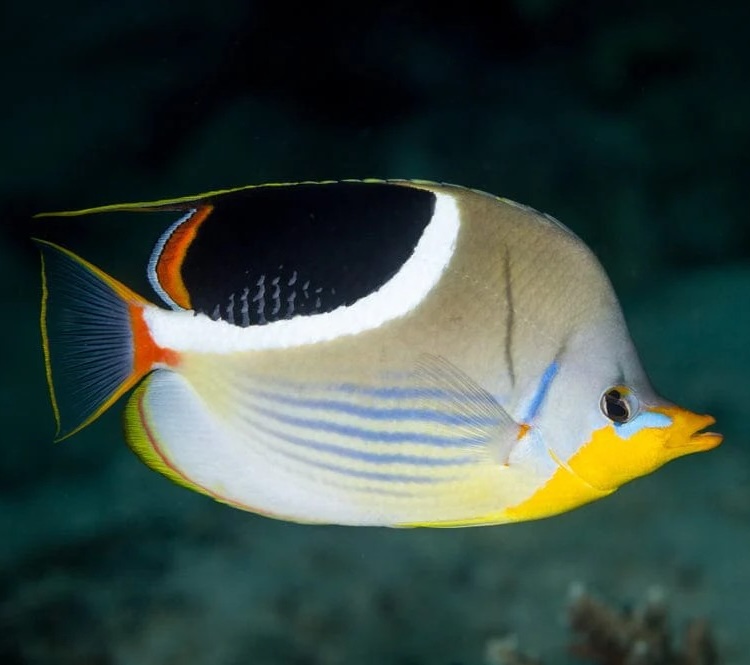
The Pearlscale Butterflyfish can grow to a standard length of 15 cm (5.9 in) with no discernible differences between males and females. The body is pearly white and the scales have black edges, giving the sides a cross-hatched pattern instead of clear chevrons. The hind parts are orangey-yellow and the base of the caudal fin is white. The head is darker than the body and bears the characteristic pattern of its lineage, consisting of vertical black eyestripes and a black white-rimmed crown spot.
Diet and Feeding
In the wild, the Pearlscale Butterflyfish feeds on algae, soft coral polyps, and small benthic invertebrates. In captivity, it should be fed a variety of foods including mysid shrimp, brine shrimp, krill, spirulina, and foods containing algae.
Behavior and Reproduction
The Pearlscale Butterflyfish has a peaceful temperament and is found either alone, in pairs, or in small groups. It is territorial towards similar-looking species and may harass them. It is an oviparous species.
Aquarium Care
A 50-gallon aquarium is the minimum size recommended for the Pearlscale Butterflyfish, with a water temperature of 74 to 80 F. Although it can be aggressive at times, it is delicate and peaceful tankmates are required for this fish to thrive. It may be compatible with other butterflyfishes that have a different color pattern. It may nip at corals, so it is not considered reef-safe.
Conservation Status
Classified as Least Concern by the IUCN Red List.
Reviews
There are no reviews yet.