
| Parameter | Value |
|---|---|
| Diet | Herbivore |
| dKH | 8-12 |
| Maximum Size | 40 cm (15.7 in) |
| Minimum Tank Size | 75 gallons (284 L) |
| pH | 8.1-8.4 |
| Temperament | Peaceful |
| Temperature | 72-82 F (22-28 C) |
| Weight | Approximately 500 g (1.1 lbs) |
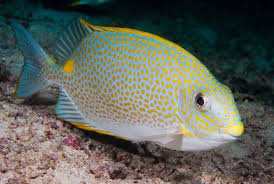
The Gold Spotted Rabbitfish (Siganus punctatus), also known as the Goldspotted Spinefoot or Spotted Rabbitfish, is a species of marine ray-finned fish belonging to the family Siganidae. It occurs in the Indo-West Pacific region.
Distribution and Habitat
The Gold Spotted Rabbitfish has a wide Indo-West Pacific distribution extending from the Cocos Islands in the eastern Indian Ocean east to Samoa, north to the Ryukyu and Ogasawara Islands of Japan and south to Australia. It occurs down to 40 meters in depth in clear lagoons and on seaward reefs as adults while juveniles school in estuaries.
Physical Description
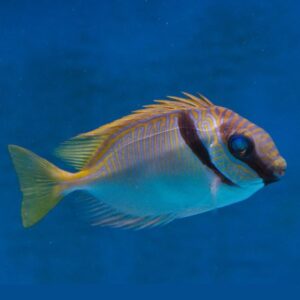
The Gold Spotted Rabbitfish attains a maximum total length of 40 cm (15.7 in) although 30 cm is more typical. The overall colour is greyish with a dense pattern of brown spots with darker margins over the head, body, and fins. There is sometimes a pale saddle on the caudal peduncle and a large ocellus to the rear of the upper margin of the gill cover. The spots on juveniles are fewer in number and larger in size.
Diet and Feeding
The Gold Spotted Rabbitfish feeds on benthic algae. In captivity it should be fed a diet rich in marine algae, spirulina, and plant-based foods supplemented with occasional meaty foods.
Behavior and Reproduction
Gold Spotted Rabbitfish live in pairs on reefs as adults while juveniles aggregate in schools of up to 50 fish. The size of the schools declines as the fish mature and they begin to pair off. This species produces venom in the spines of its fins.
Aquarium Care
It requires a tank of at least 75 gallons with ample swimming space and abundant live rock for grazing. It is generally considered reef-safe. It is peaceful and can be kept with a variety of tankmates. Handle with care as the dorsal spines are venomous.
Conservation Status
Classified as Least Concern by the IUCN Red List.
Reviews
There are no reviews yet.