
| Parameter | Value |
|---|---|
| Diet | Omnivore |
| dKH | 8-12 |
| Maximum Size | 10 cm (3.9 in) |
| Minimum Tank Size | 30 gallons (114 L) |
| pH | 8.1-8.4 |
| Temperament | Semi-aggressive |
| Temperature | 72-82 F (22-28 C) |
| Weight | Approximately 30 g (1.1 oz) at maximum size |
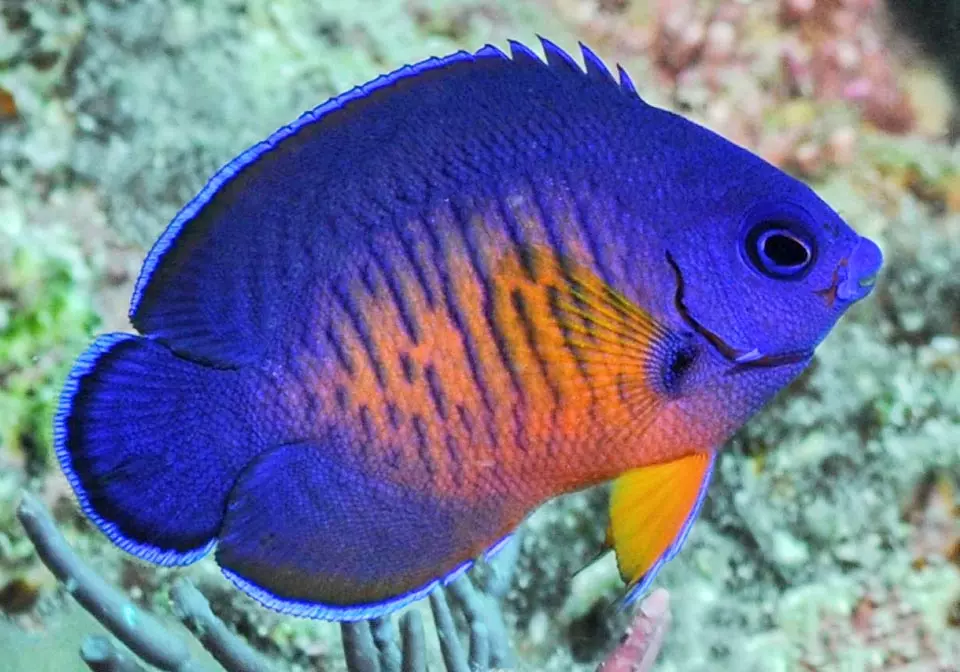
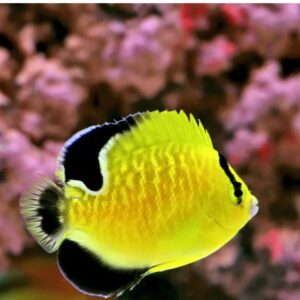
The Coral Beauty Angelfish (Centropyge bispinosa), also known as the Twospined Angelfish or Dusky Angelfish, is a species of marine angelfish belonging to the family Pomacanthidae. It was first formally described in 1860 by the German-born British ichthyologist Albert Gunther, with the type locality given as Ambon Island, Indonesia. It
Aquarium Care
is one of the most popular and frequently encountered marine angelfish in the aquarium trade. The Coral Beauty Angelfish is found throughout the Indo-Pacific.
Distribution and Habitat
Its range extends from the coast of East Africa between Tanzania and South Africa as far east as the Tuamotu Islands of French Polynesia, north to the Izu Islands of Japan, and south to Lord Howe Island. It is found at depths of 5 to 50 meters on coral reefs within lagoons, rubble patches, and drop-offs, being most common around drop-offs. The Coral Beauty Angelfish
Physical Description
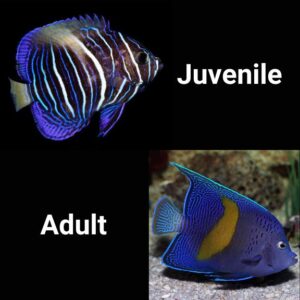
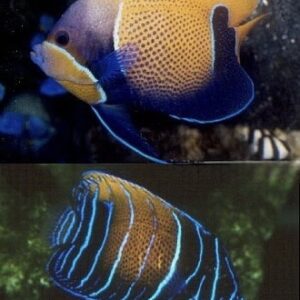
has a deep, laterally compressed body with a basic dark purplish-blue coloration. This is marked with irregular orange to reddish-gold vertical bars on the flanks, though coloration can vary significantly depending on the region of origin. The dorsal, caudal, and anal fins have a bright blue margin. The dorsal fin contains 14 spines and 17-18 soft rays while the anal fin has 3 spines and 17-19 soft rays. This species attains a maximum total length of 10 cm (3.9 in). The Coral Beauty Angelfish
Diet and Feeding
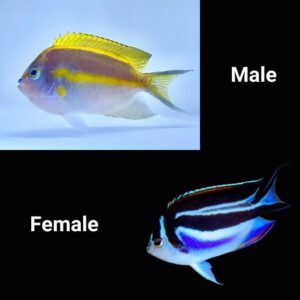
feeds on algae and detritus in the wild. In captivity, it readily accepts a varied diet including spirulina, marine algae, mysis and brine shrimp, and high-quality marine angelfish preparations. This species lives in small social groups consisting of a single male and several females.
Behavior and Reproduction
They are protogynous hermaphrodites. The Coral Beauty Angelfish is well-suited to aquarium life and is considered one of the hardier dwarf angelfish species. A tank of at least 30 gallons with abundant live rock for grazing and hiding is recommended. While generally considered more reef-safe than larger angelfish species, individual specimens may occasionally nip at corals and clams.
Conservation Status
Classified as Least Concern by the IUCN Red List.

Reviews
There are no reviews yet.