
| Parameter | Value |
|---|---|
| Diet | Omnivore |
| dKH | 8-12 |
| Maximum Size | 38 cm (15 in) |
| Minimum Tank Size | 180 gallons (681 L) |
| pH | 8.1-8.4 |
| Temperament | Semi-aggressive |
| Temperature | 72-82 F (22-28 C) |
| Weight | Approximately 700 g (1.5 lbs) at maximum size |
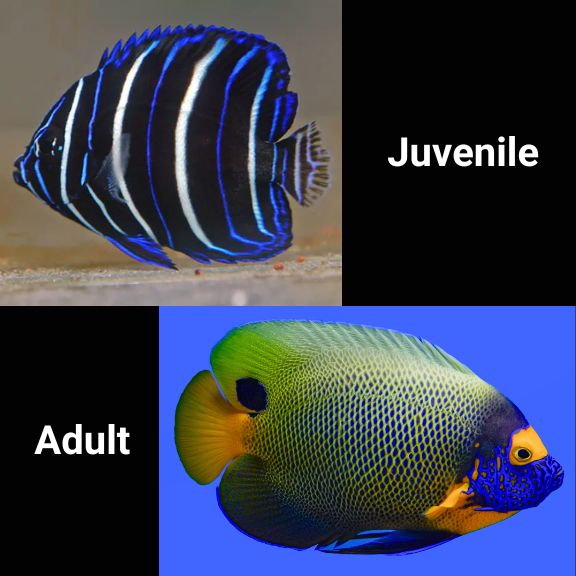
The Blueface Angelfish (Pomacanthus xanthometopon), also known as the Yellowface Angelfish, is a marine angelfish belonging to the family Pomacanthidae. It was first formally described in 1853 by the Dutch ichthyologist Pieter Bleeker. The specific name xanthometopon means ‘yellow forehead,’ a reference to the yellow mask across its eyes. The Blueface Angelfish is found on coral reefs in the eastern tropical Indo-Pacific.
Distribution and Habitat
Its range includes the Maldives, Malaysia, Indonesia, Japan, Taiwan, the Philippines, northern Australia, and Micronesia. It favors lagoons, outer reef slopes, and channels at depths down to about 25 meters and is often found among rocks and near caves. The most distinctive feature is the striking yellow mask across the face and eyes.
Physical Description
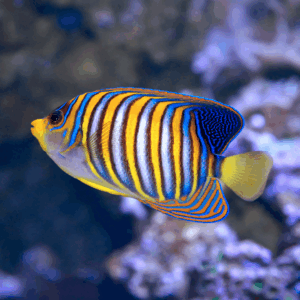
The body is a pale blue with reticulated blue and yellow patterns on the posterior portion. The fins are large and rounded, yellow in color, with some edged in blue. The dorsal fin has a distinctive black eyespot at the base and contains 13-14 spines and 16-18 soft rays. Juveniles display six vertical white bars separated by pale blue lines. The Blueface Angelfish
Diet and Feeding
feeds on tunicates, sponges, other encrusting organisms, and algae. This species
Behavior and Reproduction
usually lives singly or in pairs. It is a protogynous hermaphrodite. Due to its large adult size,
Aquarium Care
the Blueface Angelfish requires a spacious aquarium of at least 180 gallons. Not considered reef-safe.
Conservation Status
Classified as Least Concern by the IUCN Red List.


Reviews
There are no reviews yet.