
| Parameter | Value |
|---|---|
| Diet | Omnivore |
| dKH | 8-12 |
| Maximum Size | 15 cm (5.9 in) |
| Minimum Tank Size | 30 gallons (114 L) |
| pH | 8.1-8.4 |
| Temperament | Semi-aggressive |
| Temperature | 73-79 F (23-26 C) |
| Weight | Approximately 80 g (2.8 oz) at maximum size |
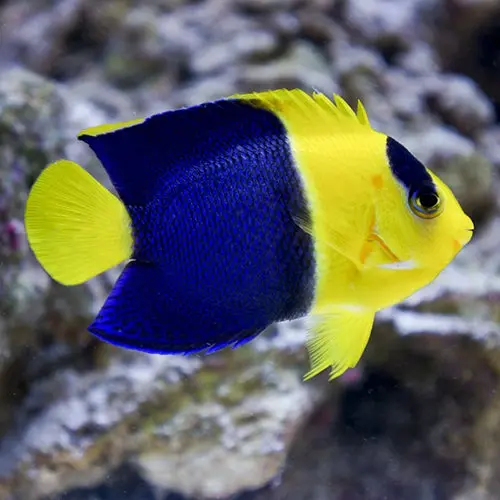
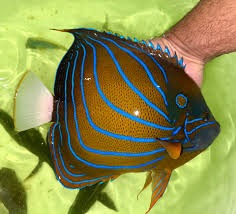
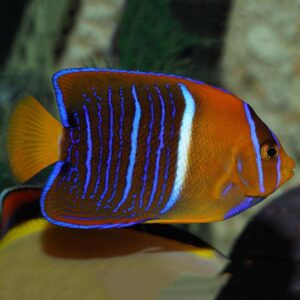
The Bicolor Angelfish (Centropyge bicolor), also known as the Pacific Rock Beauty or Oriole Angelfish, is a species of marine angelfish belonging to the family Pomacanthidae. It
Distribution and Habitat
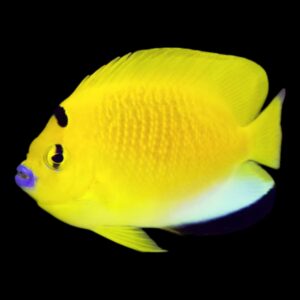
is found in the Indo-Pacific region including East Africa, southern Japan, Australia, the Philippines, and Fiji. It lives at a depth range of 1 to 25 meters and is associated with reef slopes, coral-rich areas, lagoons, and near drop-off areas. The Bicolor Angelfish displays a striking two-tone coloration. The anterior half of
Physical Description
the body is a vivid yellow-gold, while the posterior half is a deep blue. A blue band runs across the eye region. This species reaches a maximum total length of approximately 15 cm (5.9 in).
Diet and Feeding
In the wild, the Bicolor Angelfish feeds on small crustaceans such as brine and mysis shrimp, as well as tunicates, corals, sponges, worms, algae, and occasionally clams.
Aquarium Care
In captivity, it accepts a varied diet including algae, shrimp, worms, spirulina flakes, and high-quality marine angelfish preparations. The Bicolor Angelfish is moderately aggressive. Males spend most of their time guarding their territory. This species
Behavior and Reproduction
is a protogynous hermaphrodite. Due to its somewhat aggressive nature, the Bicolor Angelfish requires a tank of at least 30 gallons with abundant coral, rockwork, and multiple hiding places. It may nip at corals and clams, so it is not universally considered reef-safe.
Conservation Status
Classified as Least Concern by the IUCN Red List.

Reviews
There are no reviews yet.