
| Parameter | Value |
|---|---|
| Diet | Omnivore |
| dKH | 8-12 |
| Maximum Size | 28 cm (11 in) |
| Minimum Tank Size | 135 gallons (511 L) |
| pH | 8.1-8.4 |
| Temperament | Semi-aggressive |
| Temperature | 72-82 F (22-28 C) |
| Weight | Approximately 400 g (14.1 oz) at maximum size |
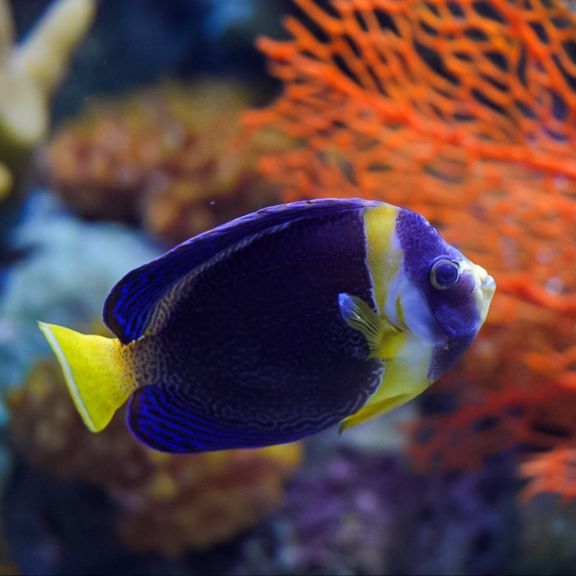
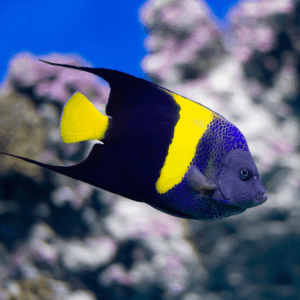
The Scribbled Angelfish (Chaetodontoplus duboulayi) is a species of marine angelfish belonging to the family Pomacanthidae. It was first formally described in 1867 by the German-born British ichthyologist Albert Gunther. The Scribbled Angelfish
Physical Description
has a largely blue body marked with darker wavy lines, giving it a ‘scribbled’ appearance. The snout is yellow, as are the pectoral, pelvic, and caudal fins. There is a yellow stripe which extends along the base of the dorsal fin and a wide vertical yellow bar to the rear of the eye, and the operculum is white. They are sexually dimorphic, with males being marked with sinuous blue lines along their flanks while females have yellow or blue spots. The dorsal fin contains 11 spines and 22 soft rays while the anal fin contains 3 spines and 21 soft rays. The Scribbled Angelfish
Distribution and Habitat
is found in the southwestern Pacific Ocean where it occurs along the northern Australian coast from Shark Bay in Western Australia to Moreton Bay in Queensland and as far south as Lord Howe Island in the Tasman Sea. It is found at depths between 5 and 20 meters on coastal and inshore reefs where there are areas of rubble, soft bottoms, or open rocky areas.
Behavior and Reproduction
They are normally encountered in small groups. They
Diet and Feeding
feed on benthic invertebrates, especially sponges and tunicates. Like all other angelfish, it is a protogynous hermaphrodite. The Scribbled Angelfish is a highly prized species
Aquarium Care
in the aquarium trade and has been successfully bred in captivity. It requires a tank of at least 135 gallons with stable water conditions and abundant live rock. Not considered reef-safe.
Conservation Status
Classified as Least Concern by the IUCN Red List.
Reviews
There are no reviews yet.