
| Parameter | Value |
|---|---|
| Diet | Omnivore |
| dKH | 8-12 |
| Maximum Size | 40 cm (15.7 in) |
| Minimum Tank Size | 180 gallons (681 L) |
| pH | 8.1-8.4 |
| Temperament | Semi-aggressive |
| Temperature | 72-82 F (22-28 C) |
| Weight | Approximately 750 g (1.7 lbs) at maximum size |
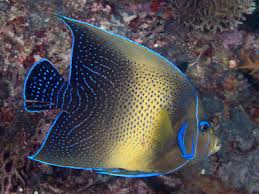
The Koran Angelfish (Pomacanthus semicirculatus), also known as the Semicircled Angelfish, Blue Angelfish, or Zebra Angelfish, is a species of marine angelfish belonging to the family Pomacanthidae. It
Distribution and Habitat
is found in the Indo-West Pacific Ocean. The Koran Angelfish, like other members of the genus Pomacanthus, has adults and juveniles which are very different from each other.
Physical Description
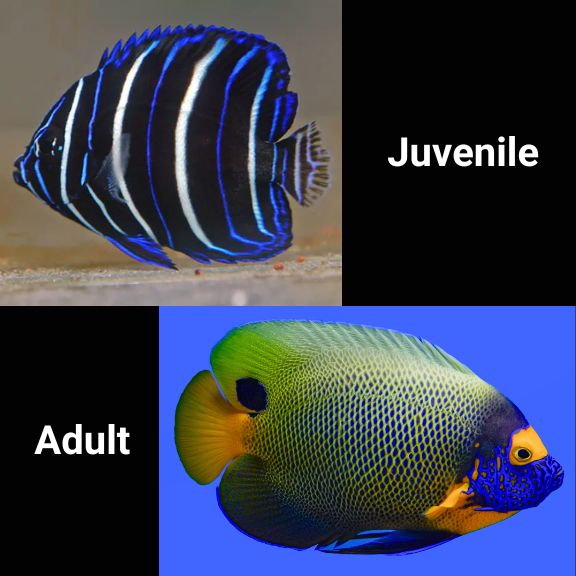
Adults are brownish green in colour with the scales edged in blue creating a blue speckling over the body and tail. All of the fins, apart from the plain yellow pectoral fins, have blue margins. There are long, filamentous growths from the dorsal and anal fins. Juveniles are blue-black marked from top to bottom with narrow white stripes. At the head end the stripes are fairly straight but they become increasingly curved as they approach the base of the tail, forming a semicircular pattern that gives the species its name. The juveniles gradually adopt the adult colouration when they are 8 to 16 centimetres in length. The Koran Angelfish is found in the Indo-Pacific region. Its range extends from the eastern coast of Africa from the southern Red Sea coast of Sudan south as far as South Africa. It is found at depths between 1 and 40 meters on sheltered coral reefs. It
Diet and Feeding
feeds on algae, tunicates, and sponges. The juveniles are very timid and occur in shallow sheltered areas, while adults show a preference for coastal reefs where there is rich coral growth. It is typically encountered in pairs or as solitary individuals.
Aquarium Care
The Koran Angelfish requires a spacious aquarium of at least 180 gallons with stable water conditions and abundant live rock. Not considered reef-safe.
Conservation Status
Classified as Least Concern by the IUCN Red List.

Reviews
There are no reviews yet.