
| Parameter | Value |
|---|---|
| Diet | Omnivore |
| dKH | 8-12 |
| Maximum Size | 25 cm (9.8 in) |
| Minimum Tank Size | 75 gallons (284 L) |
| pH | 8.1-8.4 |
| Temperament | Peaceful |
| Temperature | 72-82 F (22-28 C) |
| Weight | Approximately 150 g (5.3 oz) at maximum size |
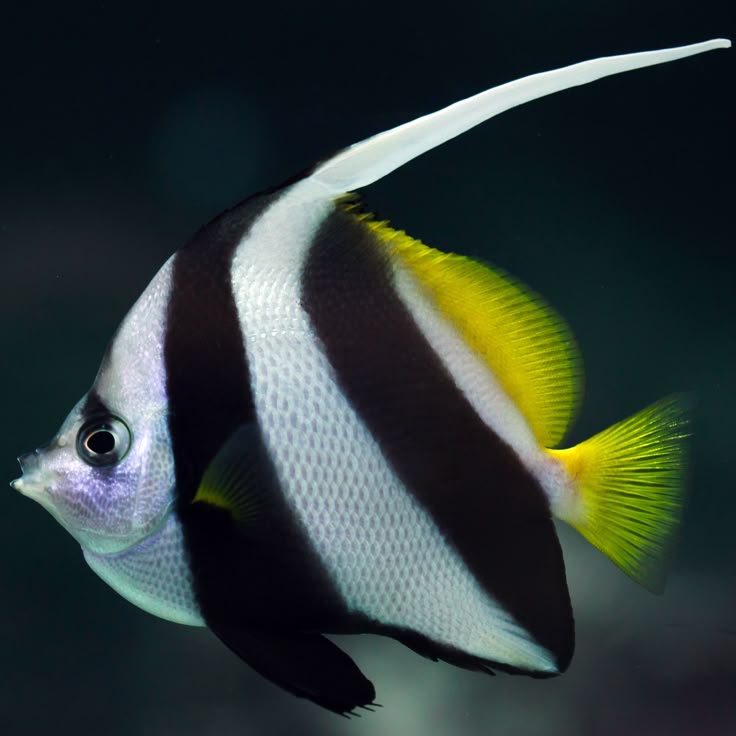
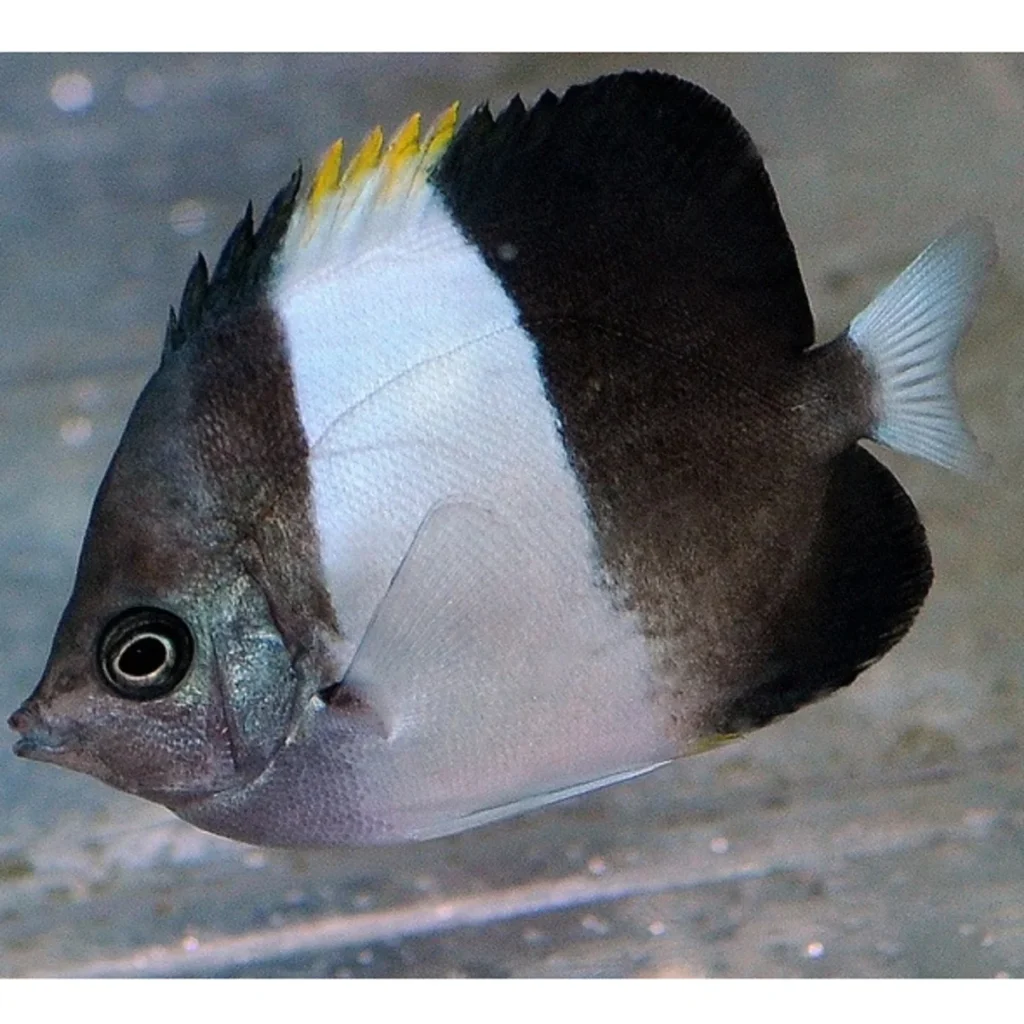
The Heniochus Black and White Butterflyfish (Heniochus acuminatus), also known as the Pennant Coralfish, Longfin Bannerfish, Reef Bannerfish, or Coachman, is a species of fish of the family Chaetodontidae. It was first described by Carl Linnaeus in 1758.
Distribution and Habitat
The Heniochus Black and White Butterflyfish is widespread throughout the tropical and subtropical waters of the Indo-Pacific from the eastern coast of Africa and the Red Sea to Polynesia. It likes relatively deep waters from protected lagoons, channels, or outer reef slopes at depths from 15 to 75 meters.
Physical Description
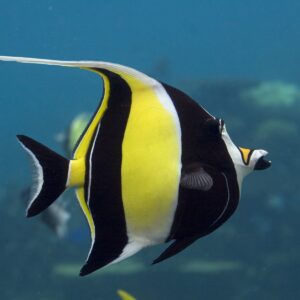
The Heniochus Black and White Butterflyfish can reach a maximum length of 25 cm, though the average size generally observed in nature is around 15 cm. Its body is compressed laterally with the first rays of the dorsal fin stretching in a long white filament. The background color is white with two large black diagonal bands. Beyond the second black stripe, the dorsal and caudal fins are yellow. The pectoral fins are also yellow. The head is white with black eyes linked by a black band. The snout is slightly stretched with a small terminal protractile mouth.
Diet and Feeding
The Heniochus Black and White Butterflyfish feeds primarily on zooplankton in the water column. In captivity, it readily accepts a varied diet including mysis shrimp, brine shrimp, frozen preparations, and marine flakes.
Behavior and Reproduction
This species is often found in schools in the wild. It is an oviparous species that forms pairs for breeding. Pelagic eggs are scattered in open water.
Aquarium Care
The Heniochus Black and White Butterflyfish requires a tank of at least 75 gallons with excellent water quality and ample swimming space. It is generally peaceful and can be kept with a variety of tankmates. It is considered more reef-safe than many other butterflyfish species due to its plankton-based diet. It can be kept in small groups in larger tanks.
Conservation Status
Classified as Least Concern by the IUCN Red List.
Reviews
There are no reviews yet.