
| Parameter | Value |
|---|---|
| Diet | Carnivore |
| dKH | 8-12 |
| Maximum Size | 20 cm (8 in) |
| pH | 8.1-8.4 |
| Temperament | Semi-Aggressive |
| Reef Safe | With Caution |
| Origin | Indo-West Pacific |
| Specific Gravity | 1.020-1.025 |
| Temperature | 72-78°F (22-26°C) |
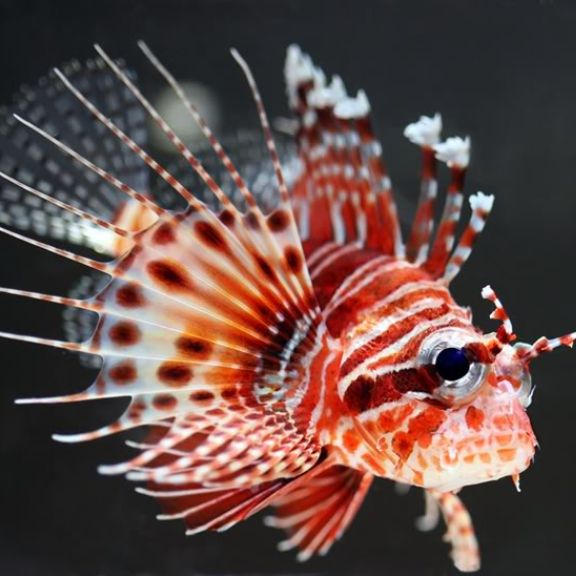
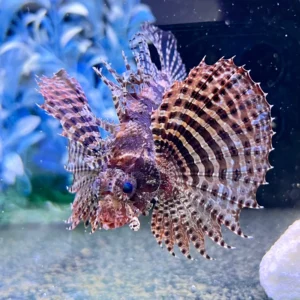
The Frillfin Lionfish (Dendrochirus bellus), also known as the Bell’s Lionfish, is a species of marine ray-finned fish belonging to the family Scorpaenidae. It is a relatively rare species in the aquarium trade compared to other Dendrochirus lionfish.
Distribution and Habitat
The Frillfin Lionfish is found in the western Pacific Ocean, primarily around Japan, Taiwan, and the Philippines. It inhabits rocky and coral reefs at depths ranging from 10 to 100 meters. It prefers deeper reef slopes and rocky substrates where it can find shelter in crevices and caves.
Physical Description
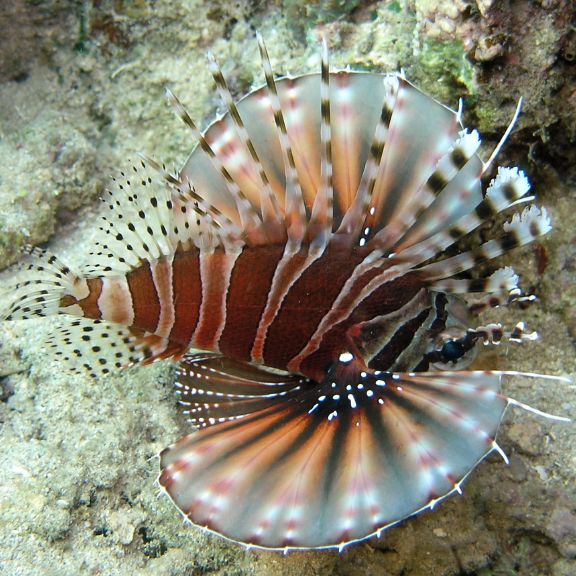
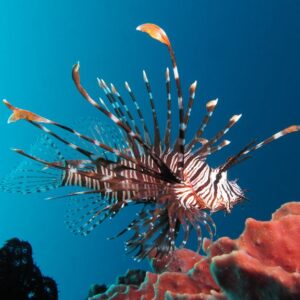
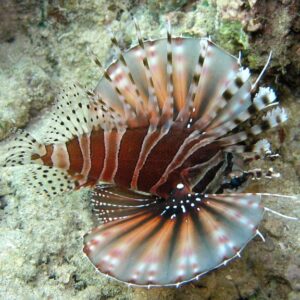
The Frillfin Lionfish reaches a maximum total length of approximately 20 cm (7.9 in). The body is reddish-orange with darker vertical bands. The pectoral fins are large and fan-shaped with distinctive frilled margins, giving the species its common name. The dorsal fin has 13 spines and the anal fin has 3 spines. The head is large with a sloping profile and the mouth is terminal.
Diet and Feeding
The Frillfin Lionfish is a carnivorous ambush predator that feeds on small fish and crustaceans. It uses its pectoral fins to corner prey before swallowing them whole. In the aquarium it accepts frozen and live meaty foods including mysis shrimp, brine shrimp, and small pieces of fish.
Behavior and Reproduction
This species is solitary and nocturnal. It spends the day hidden in crevices and becomes active at night to hunt. It is generally peaceful toward larger tankmates but will consume any fish or shrimp that fits in its mouth. Little is known about its reproductive behavior in the wild.
Aquarium Care
The Frillfin Lionfish requires a tank of at least 40 gallons with plenty of live rock and hiding places. It is generally reef-safe with caution. It should be kept with larger peaceful fish and should not be housed with aggressive species. Water temperature should be maintained between 72-82 F (22-28 C) with pH 8.1-8.4.
Conservation Status
Classified as Least Concern by the IUCN Red List.
Reviews
There are no reviews yet.