
| Parameter | Value |
|---|---|
| Diet | Omnivore |
| dKH | 8-12 |
| Maximum Size | 8 cm (3.1 in) |
| Minimum Tank Size | 30 gallons (114 L) |
| pH | 8.1-8.4 |
| Temperament | Semi-aggressive |
| Temperature | 72-82 F (22-28 C) |
| Weight | Approximately 20 g (0.7 oz) at maximum size |
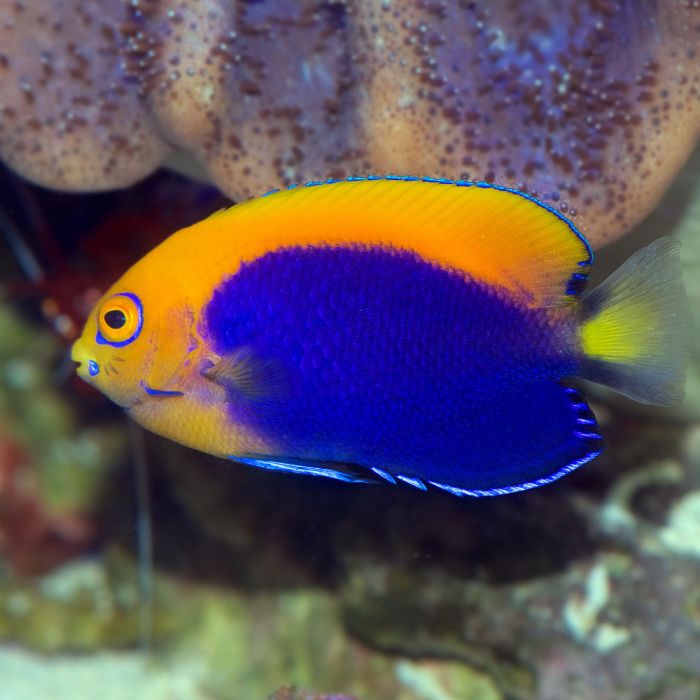
The Flameback Angelfish (Centropyge acanthops), also known as the Orangeback Angelfish or African Pygmy Angelfish, is a species of marine angelfish belonging to the family Pomacanthidae. It
Distribution and Habitat
is found in the Western Atlantic Ocean and is closely related to the Brazilian flameback angelfish (Centropyge aurantonotus). The Flameback Angelfish
Physical Description
has an oval, deep and laterally compressed body with a short, blunt snout and a small mouth. There is a long, robust spine at the angle of the preopercle. The body is mainly blue with the head and dorsal region being bright golden yellow to orange, giving it the common name. It also has a blue ring around the eyes. The caudal and anal fins are dark blue marked with many black spots. The dorsal fin contains 14-15 spines and 15-16 soft rays while the anal fin has 3 spines and 17 soft rays. This species attains a maximum total length of 8 cm (3.1 in). The Flameback Angelfish is found in the tropical Western Atlantic Ocean, occurring from the Caribbean and along the northern coast of South America. It is found at depths between 15 and 300 meters in areas of reef and rock rubble, and may also be common around isolated patches of staghorn coral. It
Diet and Feeding
feeds on algae and sponges. Like other angelfish, the Flameback Angelfish lays pelagic eggs and has pelagic larvae. The Flameback Angelfish
Aquarium Care
is popular in the aquarium trade. It requires a tank of at least 30 gallons with abundant live rock for grazing and hiding. It is semi-aggressive and may display territorial behavior toward other dwarf angelfish. While generally considered more reef-safe than larger angelfish species, individual specimens may occasionally nip at corals.
Conservation Status
Classified as Least Concern by the IUCN Red List.

Reviews
There are no reviews yet.