
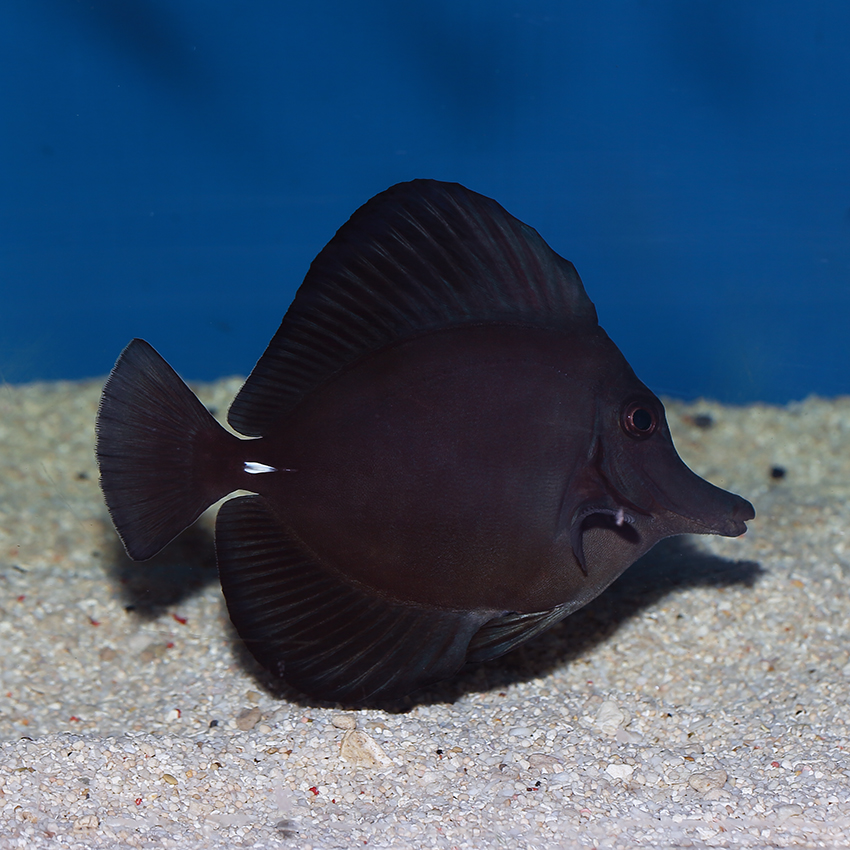
| Parameter | Value |
|---|---|
| Diet | Herbivore |
| dKH | 8-12 |
| Maximum Size | 21 cm (8.3 in) |
| Minimum Tank Size | 125 gallons (473 L) |
| pH | 8.1-8.4 |
| Temperament | Semi-aggressive |
| Temperature | 72-82 F (22-28 C) |
| Weight | Approximately 300 g (0.7 lbs) at maximum size |
The Black Tang (Zebrasoma rostratum), also known as the longnose surgeonfish or longnose tang, is a species of marine ray-finned fish belonging to the family Acanthuridae. It was first formally described in 1875 by the German-born British ichthyologist Albert Gunther with its type locality given as the Society Islands in French Polynesia. The specific name rostratum means ‘beaked’, a reference to the longer snout of this species.
Physical Description
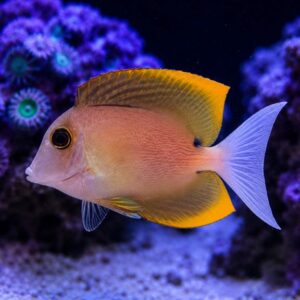
The Black Tang has a laterally compressed body with a protruding, relatively long snout. The dorsal fin is supported by 4 or 5 spines and between 23 and 28 soft rays while the anal fin is supported by 3 spines and 19 to 24 soft rays. The overall colour is black with a white patch around the spine on the caudal peduncle. Males have a patch of bristles to the front of the spine. Juveniles are grey towards the head and black on the rear. The Black Tang has a maximum published total length of 21 cm (8.3 in).
Distribution and Habitat
The Black Tang is found in the central Pacific Ocean. It ranges from Tuvalu east to Pitcairn including all of French Polynesia, north to the Line Islands and south to Rapa Iti. A vagrant has been recorded off Oahu in Hawaii. This is a benthopelagic species found at depths between 8 and 35 m on lagoon and seaward reefs.
Diet and Feeding
The Black Tang is herbivorous, grazing on filamentous algae.
Aquarium Care
The Black Tang is an uncommon and highly sought after aquarium fish. It requires a large, well-established aquarium with stable water conditions and abundant live rock. It is semi-aggressive and may display territorial behavior toward other tangs.
Conservation Status
Classified as Data Deficient by the IUCN Red List due to the lack of information on the impact of collecting for the aquarium trade.
Reviews
There are no reviews yet.