
| Parameter | Value |
|---|---|
| Diet | Carnivore |
| dKH | 8-12 |
| Maximum Size | 130 cm (51 in) |
| Minimum Tank Size | 55 gallons (208 L) |
| pH | 8.1-8.4 |
| Temperament | Peaceful |
| Temperature | 72-82 F (22-28 C) |
| Weight | Approximately 500 g (1.1 lbs) |
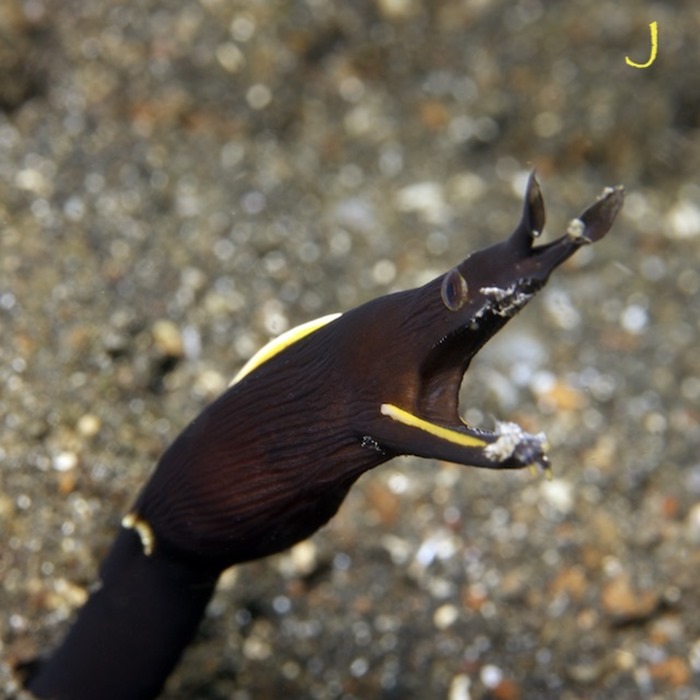
The Black Ribbon Eel (Rhinomuraena quaesita), also known as the Ribbon Eel or Leaf-nosed Moray Eel, is a species of moray eel and the only member of the genus Rhinomuraena. The black coloration represents the juvenile and subadult stage of the species.
Distribution and Habitat
The Ribbon Eel is found in tropical parts of the Indian and Pacific Oceans, ranging from East Africa to southern Japan, Australia, and French Polynesia. It is found in sand burrows and reefs at depths of 1 to 57 meters. It is widely distributed and seen by divers with their heads and anterior bodies protruding from crevices.
Physical Description
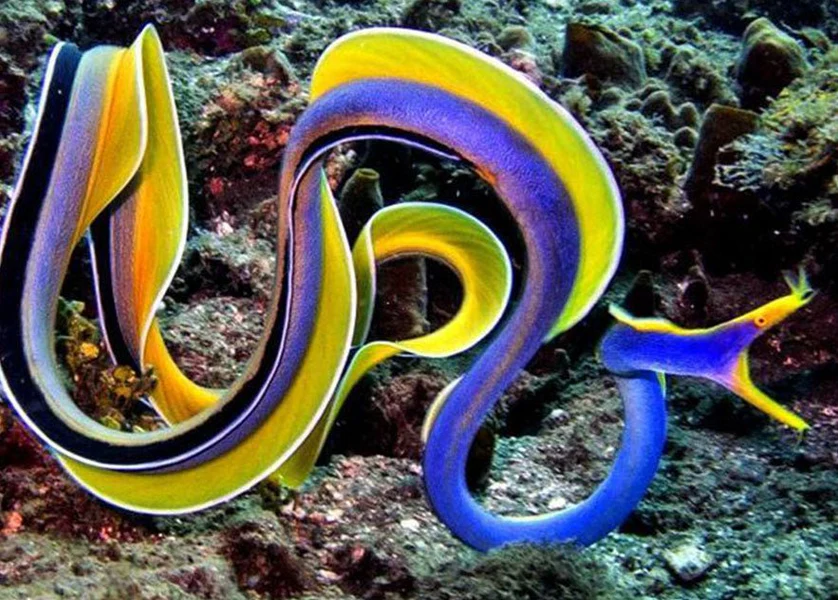
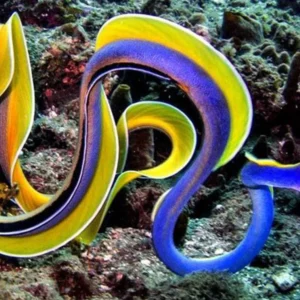
The Ribbon Eel is characterized by its long thin body and high dorsal fins. It can have up to 255 vertebrae, making it one of the most narrow and elongated eel species. In the juvenile and subadult stages ribbon eels appear primarily jet black with a yellow dorsal fin. In adult males the black is replaced by vibrant blue. Adult females are entirely yellow. The black variant represents the juvenile stage. Blue adult males range from 65 to 94 cm while yellow females can reach up to 130 cm.
Diet and Feeding
The Ribbon Eel is carnivorous, feeding on small fish and crustaceans. In captivity it can be a finicky eater and may require live foods initially.
Behavior and Reproduction
Ribbon eels are a diurnal species active during the daytime. It is generally considered a protandric hermaphrodite undergoing male to female transformation. Color change related to sex change is not known from any other moray eel species. In its natural habitat ribbon eels can live up to twenty years.
Aquarium Care
It requires a tank of at least 55 gallons with a tight-fitting lid as eels are escape artists. It needs abundant live rock with crevices and a sandy substrate. It is generally peaceful but can be difficult to acclimate to captivity. It is considered reef-safe with caution.
Conservation Status
Classified as Least Concern by the IUCN Red List.
Reviews
There are no reviews yet.