
| Parameter | Value |
|---|---|
| Diet | Omnivore |
| dKH | 8-12 |
| Maximum Size | 40 cm (15.7 in) |
| Minimum Tank Size | 125 gallons (473 L) for juveniles, 200 gallons (757 L) for adults |
| pH | 8.1-8.4 |
| Temperament | Semi-aggressive |
| Temperature | 72-82 F (22-28 C) |
| Weight | Approximately 730 g (1.6 lbs) at maximum wild size |
The Emperor Angelfish (Pomacanthus imperator) is a species of marine angelfish belonging to the family Pomacanthidae. It was first formally described in 1787 by the German physician and naturalist Marcus Elieser Bloch, with the type locality given as Japan. The specific name imperator means ’emperor’ and reflects the majestic appearance of this species. The Emperor Angelfish
Physical Description
has a broad Indo-Pacific distribution from the Red Sea to Hawaii and the Austral Islands. It
Distribution and Habitat
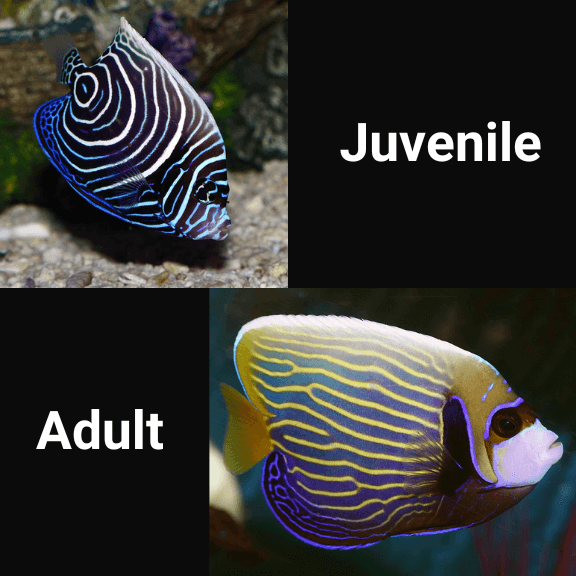
is found at depths between 1 and 100 meters. Adults inhabit areas of rich coral growth on clear lagoon, channel, or seaward reefs, typically observed beneath ledges and within caves. The Emperor Angelfish shows a marked difference between juveniles and adults. Juveniles have a dark blue body with concentric curving lines alternating between pale blue and white. Adults are striped with blue and yellow horizontal stripes, a light blue face with a dark blue mask over the eyes and a yellow caudal fin. A blackish band is present above the pectoral fins. The dorsal fin has 13-14 spines and 17-21 soft rays while the anal fin has 3 spines and 18-21 soft rays. This species reaches a maximum total length of 40 cm (15.7 in).
Diet and Feeding
In the wild, the Emperor Angelfish feeds primarily on sponges and other encrusting organisms, as well as tunicates. Both juveniles and adults may occasionally act as cleaner fish. When frightened, these fish can produce a knocking sound.
Aquarium Care
In captivity, it should be offered a varied diet including marine-based meaty foods, spirulina, marine algae, and high-quality angelfish preparations containing sponge material. The Emperor Angelfish requires a large, well-established aquarium with stable water conditions and abundant live rock creating caves and overhangs. It is considered semi-aggressive and may display territorial behavior. Only one individual should be kept per tank unless a confirmed pair is obtained. Not considered reef-safe.
Conservation Status
Classified as Least Concern by the IUCN Red List.

Reviews
There are no reviews yet.