
| Parameter | Value |
|---|---|
| Diet | Omnivore |
| dKH | 8-12 |
| Maximum Size | 18 cm (7.1 in) |
| Minimum Tank Size | 70 gallons (265 L) |
| pH | 8.1-8.4 |
| Temperament | Peaceful |
| Temperature | 72-82 F (22-28 C) |
| Weight | Approximately 120 g (4.2 oz) at maximum size |
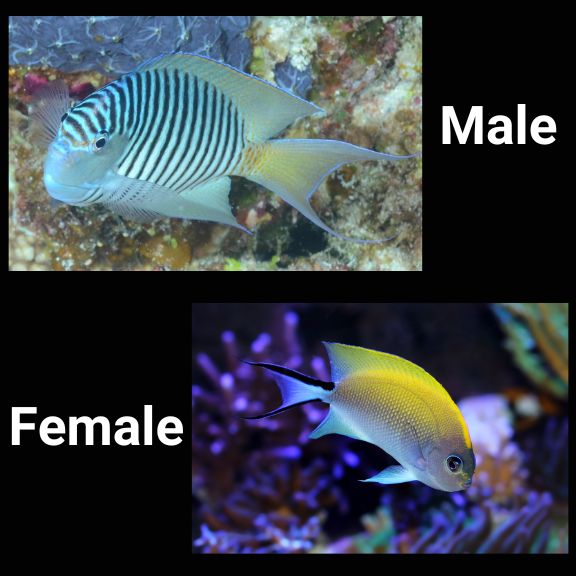
The Spotbreast Angelfish (Genicanthus melanospilos), also known as the Blackspot Angelfish or Swallowtail Angelfish, is a species of marine angelfish belonging to the family Pomacanthidae. It was first formally described in 1857 by the Dutch ichthyologist Pieter Bleeker. The specific name is a compound of melanos meaning ‘black’ and spilos meaning ‘spot,’ referring to the black spot on the male’s chest. The Spotbreast Angelfish
Physical Description
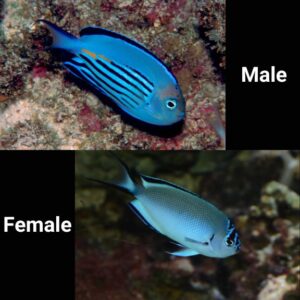
shows sexual dichromatism. Males have a background colour of bluish white on the body with many reddish black vertical stripes. Their dorsal, caudal, and anal fins are marked with yellow spots and the caudal fin is light yellow with blue margins and has long filamentous lobes. They also have a sizeable black spot on the breast near the base of the pelvic fins. In females, the dorsal half of the body is yellow, while ventrally it is bluish white, and the tail is bluish with a black stripe along its lower and upper margins. In both sexes the forked tail narrows at its base to create a swallow tail. The dorsal fin contains 15 spines and 15-17 soft rays while the anal fin has 3 spines and 17-18 soft rays. This species attains a maximum total length of 18 cm (7.1 in). The Spotbreast Angelfish is a widespread species found in the eastern Indian Ocean and the western Pacific Ocean, throughout the Malay Archipelago into the southwestern Pacific as far east as Fiji, north to the Ryukyu Islands, and south to Australia. It
Distribution and Habitat
is found at depths between 20 and 80 meters in areas rich in coral on the outer slopes of reefs and drop-offs. Adults
Behavior and Reproduction
are normally organised as small harems made up of a male and several females. They
Diet and Feeding
feed on zooplankton in the water over reefs. Like all other angelfish, it is a protogynous hermaphrodite. Unlike most angelfish, Genicanthus species are generally considered more reef-safe due to their plankton-based diet. They are peaceful and can be kept with a variety of tankmates.
Conservation Status
Classified as Least Concern by the IUCN Red List.

Reviews
There are no reviews yet.