
| Parameter | Value |
|---|---|
| Diet | Carnivore |
| dKH | 8-12 |
| Maximum Size | 20 cm (7.9 in) |
| Minimum Tank Size | 70 gallons (265 L) |
| pH | 8.1-8.4 |
| Temperament | Semi-aggressive |
| Temperature | 72-82 F (22-28 C) |
| Weight | Approximately 80 g (2.8 oz) at maximum size |
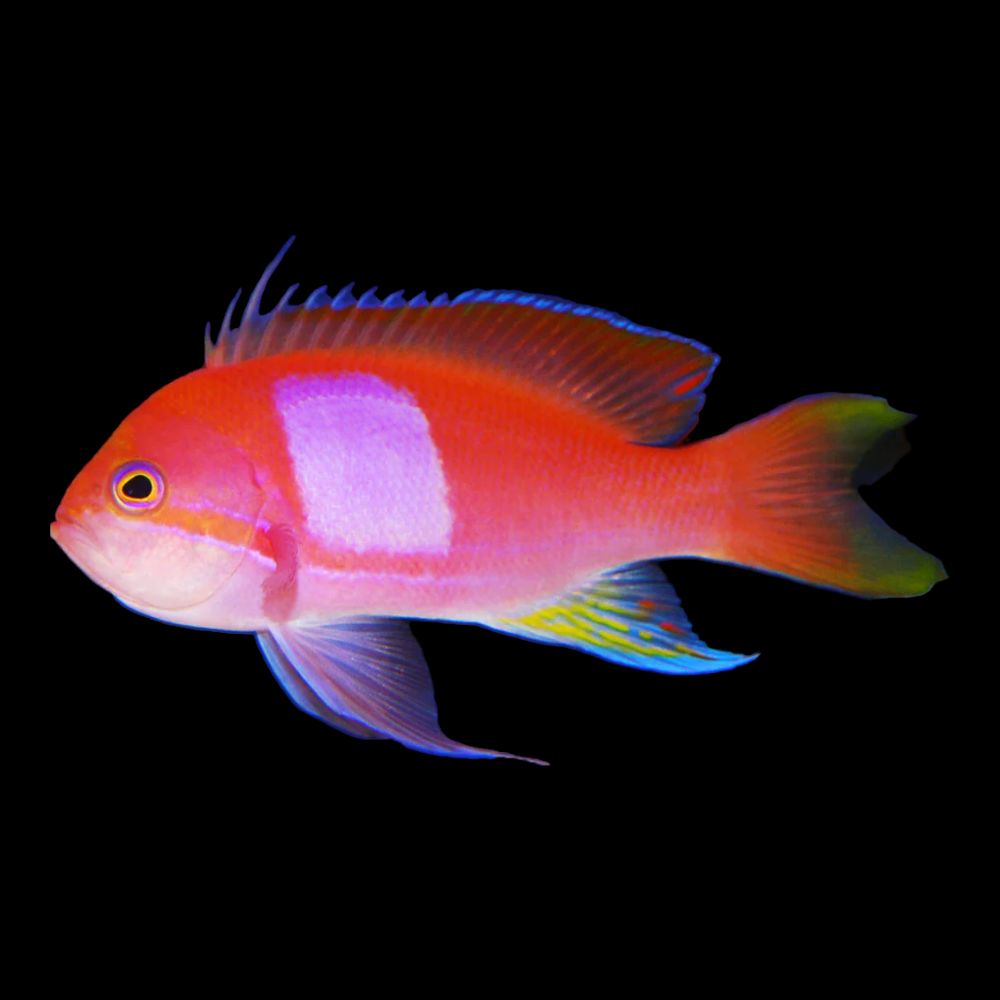
The Squareback Anthias (Pseudanthias pleurotaenia), also known as the Squarespot Anthias, Pink Square Anthias, or Squarespot Fairy Basslet, is a species of marine ray-finned fish in the subfamily Anthiinae. It is a reef-dwelling fish of the Pacific Ocean.
Distribution and Habitat
The Squareback Anthias is found around reefs at depths of 10 to 180 meters. Its range extends from Indonesia east to Samoa, north to the Ryukyu Islands, and south to Rowley Shoals and Australia.
Physical Description
The Squareback Anthias grows to a maximum length of 20 cm (7.9 in). The males are deep pink and orange in colour with a large quadrilateral purplish blotch on the flank, a red tip on the posterior margin of the dorsal fin, and mauve tips on the caudal fin lobes. There is a reddish stripe which runs along the body. Females are less colorful and lack the distinctive square blotch.
Diet and Feeding
The Squareback Anthias feeds primarily on zooplankton in the water column. In captivity it requires frequent feedings of small meaty foods such as mysis shrimp, brine shrimp, and frozen plankton preparations. Multiple small feedings per day are recommended.
Behavior and Reproduction
As with many reef fish the Squareback Anthias is a sequential hermaphrodite, beginning life as a female and transitioning to male in response to environmental and social factors. Males are territorial and maintain harems of multiple females.
Aquarium Care
The Squareback Anthias requires a tank of at least 70 gallons with excellent water quality and ample swimming space. It is semi-aggressive particularly toward other anthias of the same species. It should be kept in groups with one male and multiple females. It requires frequent feedings and good water circulation. It is considered reef-safe.
Conservation Status
Classified as Least Concern by the IUCN Red List.
Reviews
There are no reviews yet.