
| Parameter | Value |
|---|---|
| Scientific Name | Hippocampus reidi |
| Conservation Status | Vulnerable |
| Diet | Carnivore |
| Maximum Size | 15 cm |
| Temperament | Peaceful |
| Reef Safe | Yes |
| Origin | Western Atlantic |
| Temperature | 72-78°F |
The Reidi Seahorse (Hippocampus reidi), also known as the Longsnout Seahorse or Slender Seahorse, is a charismatic marine syngnathid belonging to the family Syngnathidae. Native to the warm coastal waters of the western Atlantic Ocean, it is celebrated for its graceful demeanor, vibrant color morphs, and fascinating reproductive biology.
Distribution and Habitat
The Reidi Seahorse occurs throughout the western Atlantic Ocean, ranging from North Carolina and Bermuda through Florida, the Gulf of Mexico, the Caribbean Sea, and south along the South American coast to Rio de Janeiro in Brazil. It inhabits shallow coastal habitats including lush seagrass beds (Thalassia testudinum), mangrove root networks, gorgonian forests, coral reefs, and artificial pilings down to depths of 55 meters.
Physical Description
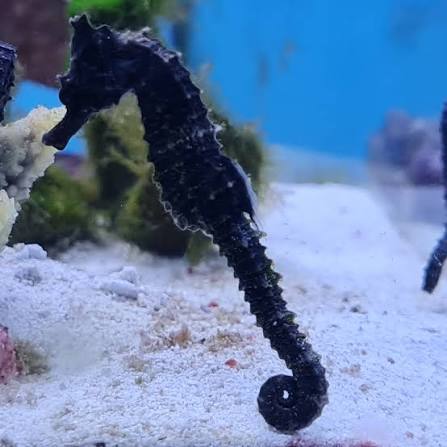
The Reidi Seahorse reaches an adult length of 15 to 17.5 cm (6 to 7 inches). It features a slender body encased in an armored skeleton composed of bony rings, a long tubular snout, and a low coronet with four to five smooth ridges. Its color is highly polymorphic, displaying shades of bright yellow, orange, red, black, pastel cream, or rich brown, frequently speckled with minute dark spots and white saddle markings. It possesses a strongly prehensile tail for grasping holdfasts and independent stereoscopic eyes that move asynchronously.
Diet and Feeding
A specialized micropredator, the Reidi Seahorse feeds continuously on tiny swimming and benthic crustaceans such as copepods, amphipods, mysid shrimp, and small larval invertebrates. It hunts by stealth, using its elongated tubular snout to create rapid buccal suction, snapping prey out of the water column. In captivity, captive-bred specimens readily feed on enriched frozen mysis shrimp fed several times daily, while wild individuals require live enriched copepods and brine shrimp.
Behavior and Reproduction
The Reidi Seahorse is a diurnal, peaceful, and slow-moving fish that spends much of its time anchored to seaweeds or coral branches. It forms monogamous breeding pairs that reinforce their bond through daily morning greeting dances and synchronized color changes. The male possesses a specialized ventral brood pouch into which the female deposits hundreds of eggs. The male fertilizes the eggs internally, gestating them for fourteen to twenty days before giving birth to active miniature fry.
Aquarium Care
A dedicated species tank or peaceful reef aquarium of 30 to 50 gallons is ideal for a pair of Reidi Seahorses. The tank must feature gentle water circulation, pristine water quality with low nutrient levels, and numerous smooth hitching posts such as gorgonians, branching macroalgae, or artificial branches. It is fully reef safe with non-stinging corals, but must never be housed with aggressive, fast-swimming fish, stinging corals, or anemones that could harm or outcompete it.
Conservation Status
Classified as Vulnerable by the IUCN Red List. Wild populations have experienced substantial declines due to coastal habitat degradation, mangrove destruction, incidental trawl bycatch, and heavy international trade for traditional medicine and ornamental pet markets.
Reviews
There are no reviews yet.