
| Parameter | Value |
|---|---|
| Diet | Carnivore |
| dKH | 8-12 |
| Maximum Size | 72 cm (28 in) |
| Minimum Tank Size | 100 gallons (379 L) |
| pH | 8.1-8.4 |
| Temperament | Peaceful |
| Temperature | 72-82 F (22-28 C) |
| Weight | Approximately 3 kg (6.6 lbs) |
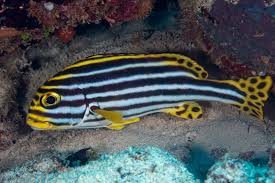
The Oriental Sweetlips (Plectorhinchus lineatus), also known as the Yellowbanded Sweetlips or Lined Sweetlips, is a species of marine ray-finned fish belonging to the family Haemulidae.
Distribution and Habitat
The Oriental Sweetlips is found in the eastern Indian Ocean and western Pacific Ocean. Its range extends from Indonesia east to the Philippines and New Ireland, north to the Ryukyu Islands and Ogasawara Islands, south to New Caledonia and Australia. It occurs in deep waters at depths between 1 and 35 meters in both inner and outer reefs.
Physical Description
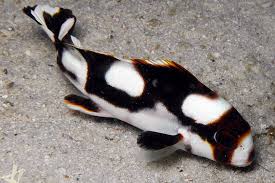
The Oriental Sweetlips attains a maximum total length of 72 cm (28 in). The overall colour is light grey which becomes white on the belly. It has prominent yellow lips and the upper part of the body is marked with a large number of broken diagonal black stripes. The fins are yellow with black spots. Juveniles have horizontal dark brown bands that break up as the fish grows.
Diet and Feeding
This species is nocturnal, foraging on open areas of sand and in beds of sea grass for benthic invertebrates during the night and resting during the day. In captivity it should be fed a variety of meaty foods including shrimp, crab, and prepared foods.
Behavior and Reproduction
The Oriental Sweetlips is typically nocturnal. It may be encountered either singly or in groups along coral slopes in clear water. The juveniles are solitary and are found on shallow sheltered reefs. Spawning aggregations have been noted off Palau around the new moon. This oviparous species forms pairs to spawn.
Aquarium Care
It requires a tank of at least 100 gallons with plenty of swimming space and hiding spots. It is peaceful and should be kept with peaceful tankmates. It is considered reef-safe with caution as it may eat small invertebrates.
Conservation Status
Classified as Least Concern by the IUCN Red List.

Reviews
There are no reviews yet.