

| Parameter | Value |
|---|---|
| Diet | Carnivore |
| dKH | 8-12 |
| Maximum Size | 50 cm (20 in) |
| Minimum Tank Size | 100 gallons (379 L) |
| pH | 8.1-8.4 |
| Temperament | Aggressive |
| Temperature | 72-82 F (22-28 C) |
| Weight | Approximately 1.5 kg (3.3 lbs) |
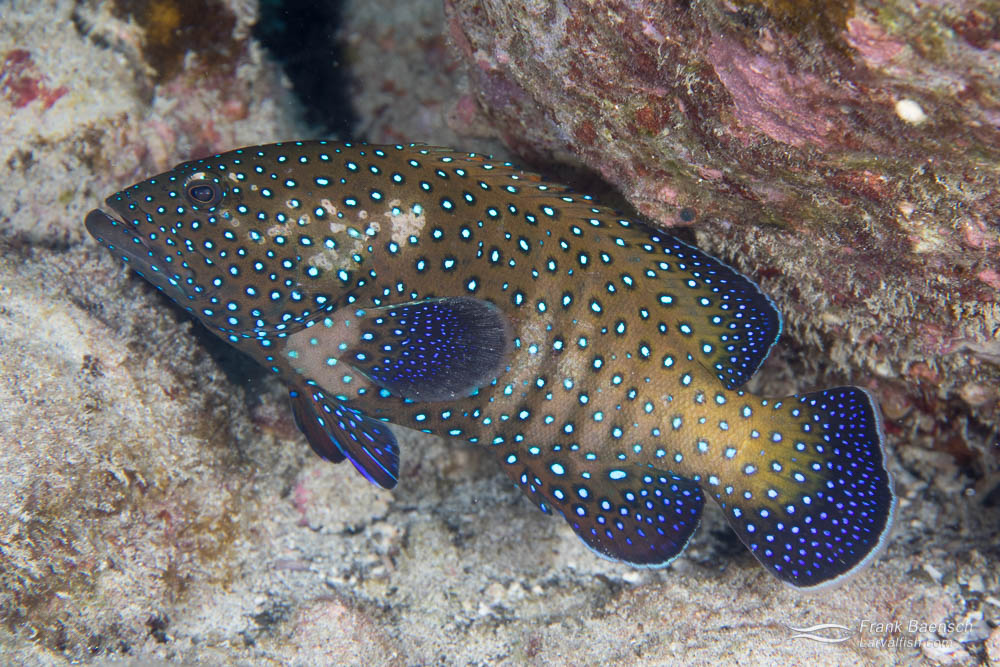
The Miniatus Grouper (Cephalopholis miniata), also known as the Coral Grouper, Coral Hind, or Coral Trout, is a species of marine ray-finned fish belonging to the family Epinephelidae.
Distribution and Habitat
The Miniatus Grouper has a wide Indo-Pacific distribution from the eastern coast of Africa where it occurs from the Red Sea to Durban in South Africa and east through the Indian Ocean and into the Pacific as far as the Line Islands. It occurs as far north as southern Japan and south to northern Australia. It is found in clear water where there are coastal and offshore coral reefs, preferring exposed rather than protected areas. It is often seen in caves and below ledges at depths of 2 to 150 meters.
Physical Description
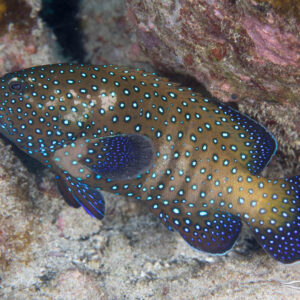
The Miniatus Grouper attains a maximum total length of 50 cm (20 in). The colour of the body is orange-red to reddish brown with many small bright blue spots that cover the head, body, and the dorsal, anal, and caudal fins. They sometimes have diagonal paler bars on the flanks. Juveniles are orange to yellow with fewer widely separated faint blue spots.
Diet and Feeding
Over 80 percent of its diet consists of small fish which are ambushed by the coral hind in a sudden rush up from the substrate. The remainder of its diet consists of crustaceans. In captivity it should be fed a variety of meaty foods including fish and shrimp.
Behavior and Reproduction
They form harems consisting of a single male and up to 12 females. The male defends the harem’s territory. Coral hinds are protogynous hermaphrodites and they change sex from female to male.
Aquarium Care
It requires a tank of at least 100 gallons with plenty of caves and ledges for hiding. It is aggressive and should be kept with similarly sized or larger tankmates. It will eat smaller fish and should not be housed with small peaceful species. It is a hardy aquarium fish.
Conservation Status
Classified as Least Concern by the IUCN Red List.

Reviews
There are no reviews yet.