
| Parameter | Value |
|---|---|
| Scientific Name | Heterodontus francisci |
| Conservation Status | Data Deficient |
| Diet | Carnivore |
| Maximum Size | 122 cm (48 in) |
| Temperament | Semi-aggressive |
| Reef Safe | No |
| Origin | Eastern Pacific |
| Temperature | 59-68 F (15-20 C) |
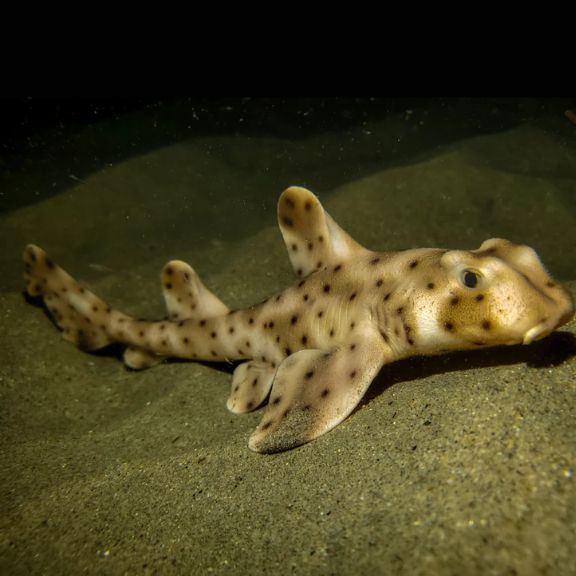
The Horn Shark (Heterodontus francisci) is a small distinctive bullhead shark of the family Heterodontidae, native to the cool eastern Pacific. Named for the horn-like ridges above its eyes, it is a robust bottom-dwelling species with a prehistoric appearance suited to specialized cool-water systems.
Distribution and Habitat
The Horn Shark is found along the eastern Pacific coast from central California to the Gulf of California in Mexico. It inhabits rocky reefs, kelp forests, and sandy areas at depths of 2 to 150 meters. It shows strong site fidelity, often returning to the same resting spot.
Physical Description
The Horn Shark has a stocky tapering body with a broad blunt head and a horn-like ridge above each eye. Its colour is dark grey-brown overlaid with small black spots for camouflage. A small rounded dorsal fin carries a stout spine, as does the second dorsal. It reaches 122 cm (48 inches).
Diet and Feeding
The Horn Shark is a nocturnal carnivore that feeds on crabs, shrimp, sea urchins, abalone, and small fish. Its powerful jaws and crushing molars are adapted to break hard shells. In captivity it accepts chopped fish, squid, and shell-on crustaceans.
Behavior and Reproduction
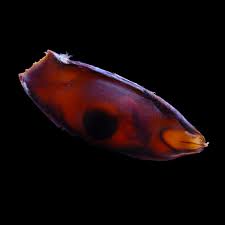
The Horn Shark is a solitary nocturnal bottom-dweller that rests in crevices by day and hunts near the substrate at night. It breathes by buccal pumping. Reproduction is oviparous, with females laying distinctive spiral egg cases wedged into crevices.
Aquarium Care
The Horn Shark requires at least 180 gallons (681 L) with a cool water temperature of 59-68 F (15-20 C). It needs a spacious rocky environment with caves and deep smooth sand. It is not reef safe, as it will consume ornamental crustaceans.
Conservation Status
Classified as Data Deficient by the IUCN Red List.

Reviews
There are no reviews yet.