
| Parameter | Value |
|---|---|
| Diet | Carnivore |
| dKH | 8-12 |
| Maximum Size | 19 cm (7.5 in) |
| pH | 8.1-8.4 |
| Temperament | Peaceful |
| Reef Safe | Yes |
| Origin | Indo-West Pacific |
| Specific Gravity | 1.020-1.025 |
| Temperature | 72-78°F (22-26°C) |
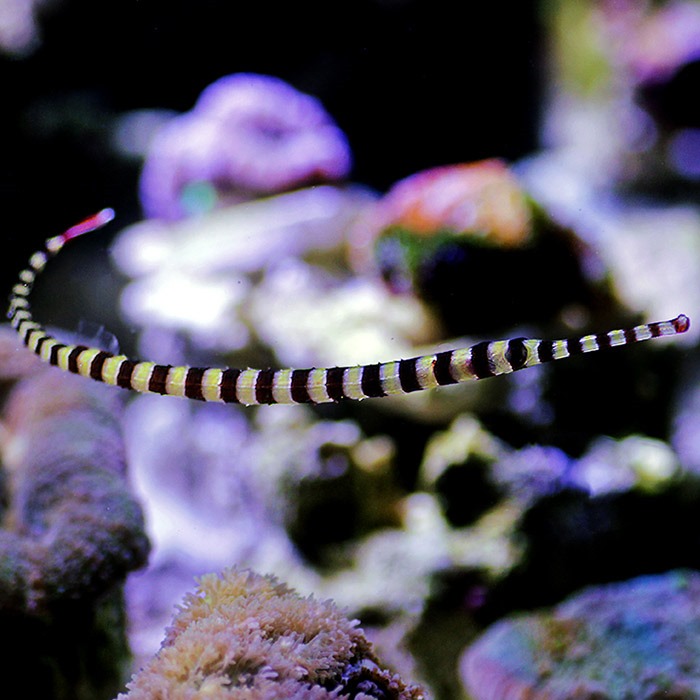
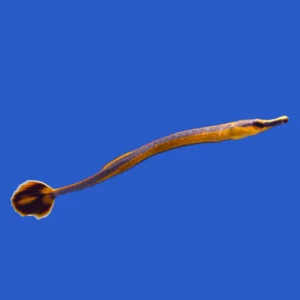
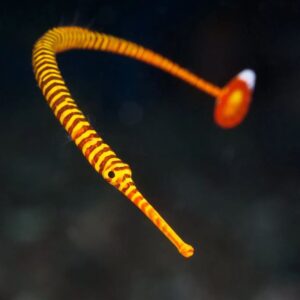
The Banded Pipefish (Dunckerocampus dactyliophorus), also known as the Ringed Pipefish or Banded Pipefish, is a species of marine ray-finned fish belonging to the family Syngnathidae. It was first formally described in 1853 by the Dutch ichthyologist Pieter Bleeker. The specific name dactyliophorus means "finger-bearing" in reference to the finger-like projections on the body rings.
Distribution and Habitat
The Banded Pipefish is found in the Indo-Pacific from the Red Sea and East Africa to the Society Islands, north to southern Japan and south to northern Australia. It inhabits coral reefs and rocky substrates at depths from 1 to 30 meters. It is typically found in caves, under overhangs, and on vertical reef walls where it can orient itself in a vertical position.
Physical Description
The Banded Pipefish reaches a maximum total length of 19 cm (7.5 in). The body is elongated and tubular with a small mouth at the end of a long snout. The body is white to pale yellow with approximately 16-20 dark brown to black vertical bands encircling the body. The snout is long and tubular. The dorsal fin is located on the posterior half of the body. Unlike seahorses, pipefish do not have a prehensile tail.
Diet and Feeding
The Banded Pipefish is a carnivorous micro-predator that feeds on tiny crustaceans including copepods, amphipods, and mysid shrimp. It uses its tubular snout to create suction and capture individual prey items. In the aquarium it requires a steady supply of small live foods such as copepods and baby brine shrimp. It can be trained to accept frozen foods such as finely chopped mysis shrimp.
Behavior and Reproduction
This species is generally found in pairs or small groups. It is a slow-moving fish that relies on camouflage among the reef structure. Reproduction involves the female transferring eggs to the male’s brood pouch on the underside of the body where they are fertilized and incubated. The male gives birth to fully formed miniature pipefish.
Aquarium Care
The Banded Pipefish requires a tank of at least 30 gallons with plenty of live rock and hiding places. It is a peaceful species that should be kept with other non-aggressive fish. It requires multiple feedings per day of small foods. It is generally reef-safe. Water temperature should be maintained between 72-78 F (22-26 C) with pH 8.1-8.4 and dKH 8-12.
Conservation Status
Classified as Least Concern by the IUCN Red List.



Reviews
There are no reviews yet.