
| Parameter | Value |
|---|---|
| Diet | Omnivore |
| dKH | 8-12 |
| Maximum Size | 18 cm (7.1 in) |
| Minimum Tank Size | 70 gallons (265 L) |
| pH | 8.1-8.4 |
| Temperament | Peaceful |
| Temperature | 72-82 F (22-28 C) |
| Weight | Approximately 120 g (4.2 oz) at maximum size |
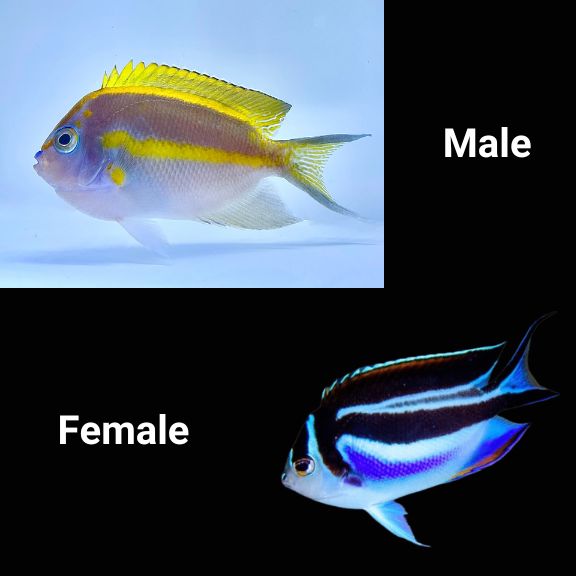
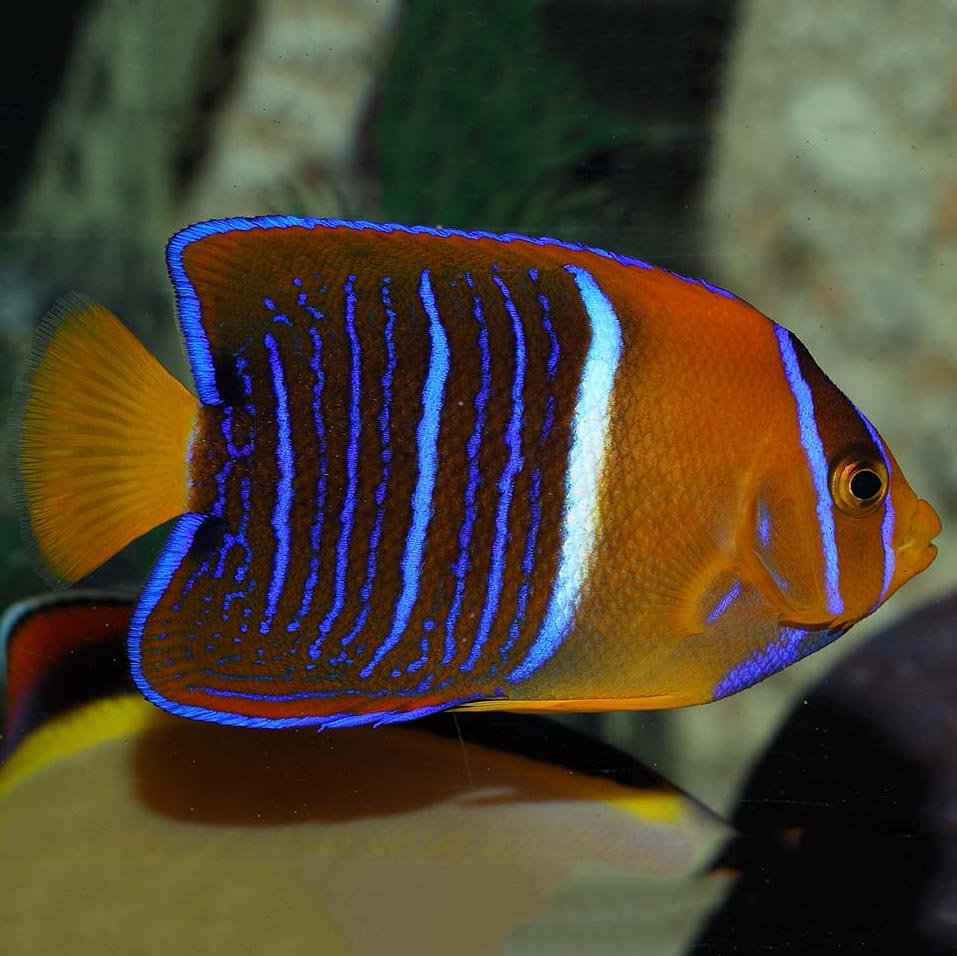
The Bellus Angelfish (Genicanthus bellus), also known as the Ornate Angelfish or Bellus Lyretail Angelfish, is a species of marine angelfish belonging to the family Pomacanthidae. It was first formally described in 1975 by the American ichthyologist John Ernest Randall. The specific name bellus means ‘beautiful.’ The Bellus Angelfish
Distribution and Habitat
has a wide but localized distribution in the western Pacific Ocean and eastern Indian Ocean, recorded from Tahiti, Guam, Palau, Tonga, the Cook Islands, the Marshall Islands, the Philippines, southern Japan, and southern Indonesia. It is found at depths between 25 and 100 meters, living on deep reefs frequently in areas swept by strong currents on outer drop-offs. The Bellus Angelfish
Physical Description
is sexually dichromatic. Females and juveniles have a greyish to bluish background coloration marked with wide black bands and a blue longitudinal stripe on the lower flanks. Males have a pale bluish to greyish background with horizontal golden stripes along the center of the flanks. The caudal fin is frequently marked with patches of orange, has filamentous extensions, and is bright blue. The dorsal fin contains 15 spines and 15-16 soft rays while the anal fin has 3 spines and 16-17 soft rays. The Bellus Angelfish
Diet and Feeding
feeds mainly on plankton, forming shoals in midwater to feed. It also consumes benthic invertebrates such as polychaetes and bryozoans, as well as algae. This is a
Behavior and Reproduction
sociable species that lives in schools with harems of 3-7 fish. Unlike most angelfish, Genicanthus species are generally considered more reef-safe due to their plankton-based diet. They are peaceful and can be kept with a variety of tankmates.
Conservation Status
Classified as Least Concern by the IUCN Red List.

Reviews
There are no reviews yet.