
| Parameter | Value |
|---|---|
| Diet | Carnivore |
| dKH | 8-12 |
| Maximum Size | 30 cm (12 in) |
| pH | 8.1-8.4 |
| Temperament | Peaceful |
| Reef Safe | Yes |
| Origin | Indo-West Pacific |
| Specific Gravity | 1.020-1.025 |
| Temperature | 72-78°F (22-26°C) |
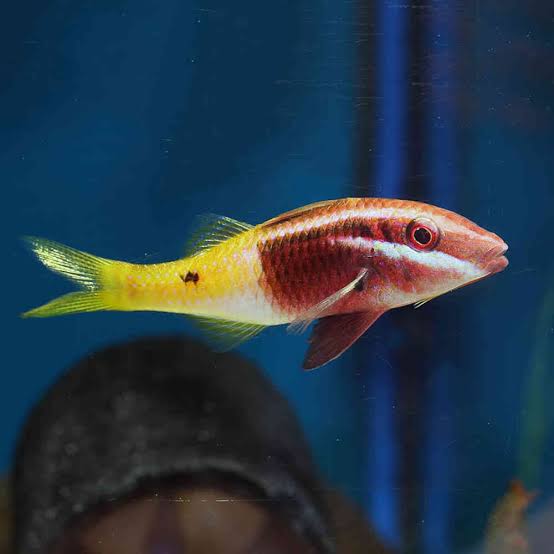
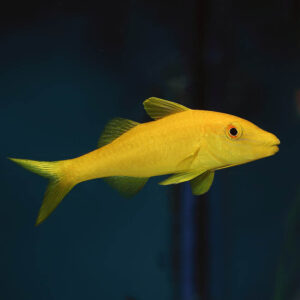
The Bicolor Goatfish (Parupeneus barberinoides), also known as the Half-and-Half Goatfish or Barber’s Goatfish, is a species of marine ray-finned fish belonging to the family Mullidae. It was first formally described in 1852 by the Dutch ichthyologist Pieter Bleeker. The species is named after the Barber Islands (now part of Indonesia) where the type specimen was collected.
Distribution and Habitat
The Bicolor Goatfish is found in the western Pacific Ocean from the Philippines and Indonesia to the Solomon Islands, north to southern Japan and south to northern Australia. It inhabits coral reefs and adjacent sandy substrates at depths from 1 to 30 meters. It is commonly found on reef flats and slopes where it forages in the sand near coral formations.
Physical Description
The Bicolor Goatfish reaches a maximum total length of 30 cm (11.8 in). The body is distinctly divided into two color zones: the anterior half is white to pale yellow while the posterior half is dark brown to black. The head has a yellowish tint with a dark bar running through the eye. The most distinctive feature is the pair of long, whisker-like barbels on the chin that are used to detect food in the sand. The dorsal fin has two parts: the first with 8 spines and the second with 1 spine and 8 soft rays.
Diet and Feeding
The Bicolor Goatfish is a benthic carnivore that uses its barbels to probe the sand for small invertebrates, including crustaceans, polychaete worms, and small mollusks. It often forages in small groups, stirring up the sand with its barbels and snatching prey as it emerges. In the aquarium it accepts a variety of meaty foods including frozen mysis shrimp, brine shrimp, and chopped seafood.
Behavior and Reproduction
This species is diurnal and often found in small groups. It is generally peaceful and can be kept with a variety of tankmates. It is an active swimmer that spends much of its time foraging in the sand. Reproduction involves pelagic spawning where eggs and sperm are released into the water column.
Aquarium Care
The Bicolor Goatfish requires a tank of at least 50 gallons with a sandy substrate for foraging and plenty of swimming space. It is generally reef-safe but may disturb sand-dwelling invertebrates. It is compatible with a wide range of peaceful fish. Water temperature should be maintained between 72-82 F (22-28 C) with pH 8.1-8.4 and dKH 8-12.
Conservation Status
Classified as Least Concern by the IUCN Red List.
Reviews
There are no reviews yet.