
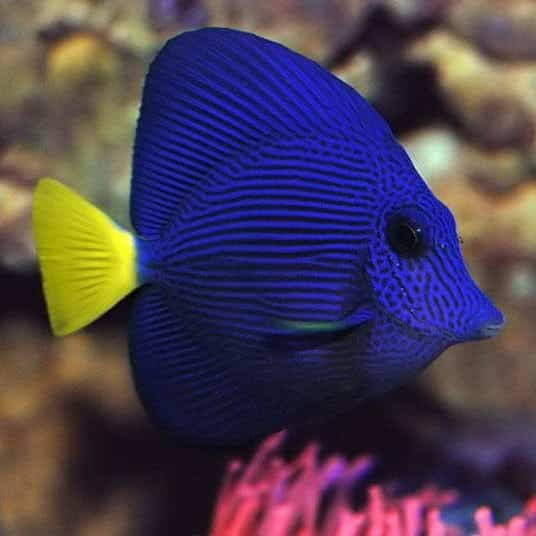
| Parameter | Value |
|---|---|
| Diet | Herbivore |
| dKH | 8-12 |
| Maximum Size | 22 cm (8.7 in) |
| Minimum Tank Size | 125 gallons (473 L) |
| pH | 8.1-8.4 |
| Temperament | Semi-aggressive |
| Temperature | 72-82 F (22-28 C) |
| Weight | Approximately 350 g (0.8 lbs) at maximum size |
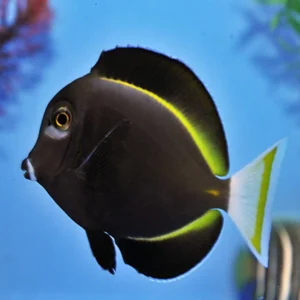
The Purple Tang (Zebrasoma xanthurum), also known as the yellowtail tang, is a species of marine ray-finned fish belonging to the family Acanthuridae. It was first formally described in 1852 by the English zoologist Edward Blyth. The specific name xanthurum means ‘yellow tail’, a reference to the yellow caudal fin of this species. This species is endemic to the north western Indian Ocean.
Physical Description
The Purple Tang has its dorsal fin supported by 5 spines and 24 or 25 soft rays while the anal fin is supported by 3 spines and 19 or 20 soft rays. This species has a deep laterally compressed body, a protruding snout and high dorsal and anal fins. There is a velvet-like patch of bristles on the caudal peduncle anterior to the spine. The head and body of adults are dark blue to purple, contrasting with the bright yellow caudal fin. The head and anterior part of the body are marked with black spots and these extend onto the adjacent fins. There are irregular black horizontal lines on the rest of the body and fins apart from the caudal fin. The pectoral fins have the outer third coloured yellow. Juveniles and subadults have dark brown longitudinal lines on their bodies.
Distribution and Habitat
The Purple Tang is endemic to the north western Indian Ocean where it is found in the Red Sea and the Gulf of Aden and around the coasts of the Arabian Peninsula into the Persian Gulf. It is also found around Socotra. These fishes are found in groups at depths down to 20 m over coral rich or rocky areas.
Diet and Feeding
The Purple Tang is a herbivorous grazer of filamentous algae. They follow a daily pattern of feeding in single individuals or pairs during the day and at sunset they stop feeding and move into their shelter for the night among corals or in crevices. The juveniles are cryptic and hide among coral.
Aquarium Care
The Purple Tang requires a well-established aquarium of at least 125 gallons with stable water conditions and abundant live rock. It is semi-aggressive and may display territorial behavior toward other tangs. Generally considered reef-safe.
Conservation Status
Classified as Least Concern globally by the IUCN Red List, but assessed as Vulnerable in the Persian Gulf.
Reviews
There are no reviews yet.