

| Parameter | Value |
|---|---|
| Diet | Carnivore |
| dKH | 8-12 |
| Maximum Size | 72 cm (28 in) |
| Minimum Tank Size | 100 gallons (379 L) |
| pH | 8.1-8.4 |
| Temperament | Peaceful |
| Temperature | 72-82 F (22-28 C) |
| Weight | Approximately 7 kg (15 lbs) |
The Spotted Sweetlips (Plectorhinchus chaetodonoides), also known as the Harlequin Sweetlips or Clown Sweetlips, is a species of marine ray-finned fish belonging to the family Haemulidae.
Distribution and Habitat
The Spotted Sweetlips is distributed across the eastern Indian Ocean and the western Pacific Ocean from the Maldives and Mauritius east as far as Tonga, north to the Ryukyu Islands and south to the Great Barrier Reef. It is found in coral-rich parts of clear lagoons and on seaward reefs.
Physical Description
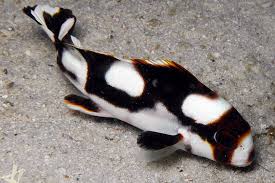
The Spotted Sweetlips has a maximum recorded total length of 72 cm (28 in), although 60 cm (24 in) is more typical. The juveniles are brownish with large discrete creamy white blotches on the body that develop brown spotting as the fish matures. As they grow into adults the coloration slowly develops a greyish background colour broken by large dark brown spots.
Diet and Feeding
This is a carnivorous species which preys on benthic invertebrates such as crustaceans and molluscs as well as fishes, which it forages for during the night. In captivity it should be fed a variety of meaty foods including shrimp, crab, and prepared foods.
Behavior and Reproduction
The adults are solitary fish, living in the vicinity of and sheltering beneath ledges or caves during the day. The juveniles are found sheltering in corals. The juveniles typically swim in a head down posture wildly undulating their fins as they swim, a behaviour which may mimic toxic or distasteful flatworms.
Aquarium Care
It requires a tank of at least 100 gallons with plenty of hiding spots and caves. It is peaceful and should be kept with peaceful tankmates. It is considered reef-safe with caution as it may eat small invertebrates. The small colourful juveniles are collected for the aquarium trade.
Conservation Status
Classified as Least Concern by the IUCN Red List.
Reviews
There are no reviews yet.