
| Parameter | Value |
|---|---|
| Diet | Omnivore |
| dKH | 8-12 |
| Maximum Size | 7.5 cm (3 in) |
| Minimum Tank Size | 30 gallons (114 L) |
| pH | 8.1-8.4 |
| Temperament | Peaceful |
| Temperature | 72-82 F (22-28 C) |
| Weight | Approximately 20 g (0.7 oz) at maximum size |
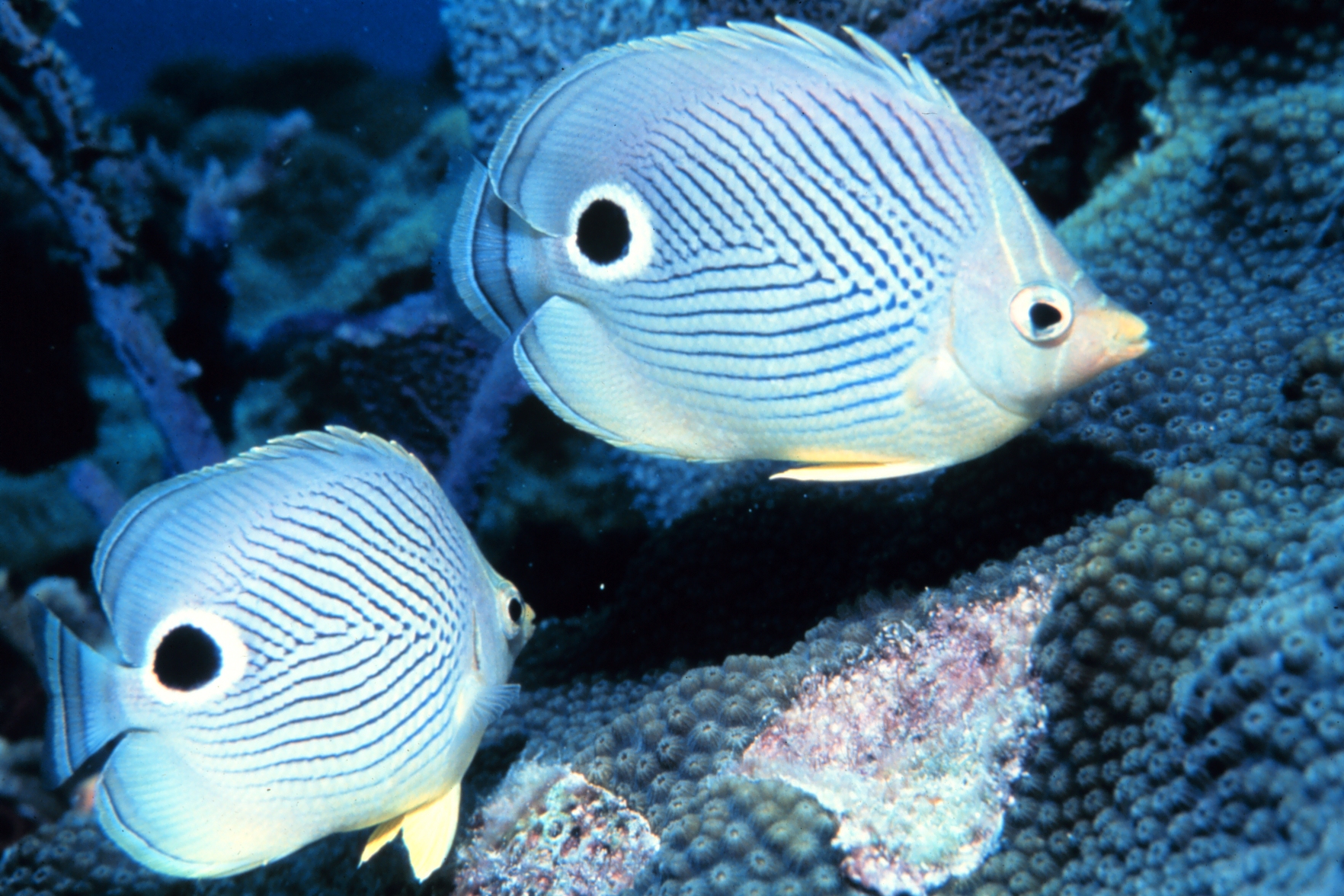
The Four Eyed Butterflyfish (Chaetodon capistratus), also known as the Foureye Butterflyfish, is a species of marine ray-finned fish in the butterflyfish family Chaetodontidae. It is the type species of the genus Chaetodon. This species is found in the Western Atlantic.
Distribution and Habitat
The Four Eyed Butterflyfish is found in the Western Atlantic from New England through Bermuda and the West Indies to northern South America. It usually frequents shallow inshore waters.
Physical Description
The Four Eyed Butterflyfish is deep-bodied and laterally compressed with a single dorsal fin and a small mouth with tiny bristle-like teeth. The body is light grey, sometimes with a yellowish hue, marked with many forward-pointing dark chevrons. At the rear portion of each side of the body, the chevrons are replaced by a white-margined black ocellus which is vertically oval in juveniles and more circular in adults. This feature leads to the common name of the species.
Diet and Feeding
The Four Eyed Butterflyfish feeds on a variety of invertebrates, mainly zoantharians, sea anemones, polychaete worms, gorgonians, and crustaceans. It may also eat fish eggs. In captivity, it accepts a varied diet including mysis shrimp, brine shrimp, and frozen preparations.
Behavior and Reproduction
Like its relatives, the Four Eyed Butterflyfish mates for life and is often seen in pairs. This monogamous behavior is rare among fishes. It is an oviparous species.
Aquarium Care
The Four Eyed Butterflyfish requires a tank of at least 30 gallons with stable water conditions and abundant live rock. It is peaceful and can be kept with a variety of tankmates. It may nip at corals, so it is not universally considered reef-safe.
Conservation Status
Classified as Least Concern by the IUCN Red List.

Reviews
There are no reviews yet.