
| Parameter | Value |
|---|---|
| Diet | Carnivore |
| dKH | 8-12 |
| Maximum Size | 15 cm (5.9 in) |
| Minimum Tank Size | 55 gallons (208 L) |
| pH | 8.1-8.4 |
| Temperament | Peaceful |
| Temperature | 72-82 F (22-28 C) |
| Weight | Approximately 40 g (1.4 oz) at maximum size |
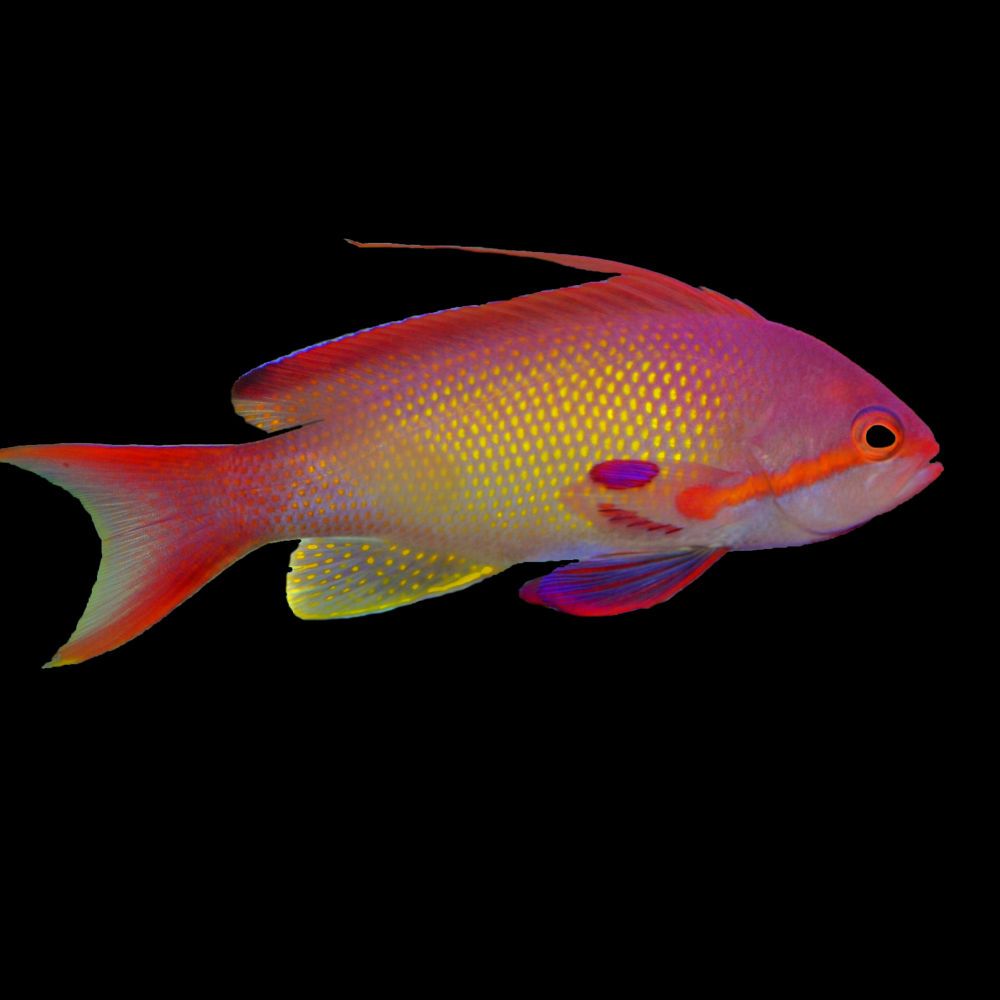
The Lyretail Anthias (Pseudanthias squamipinnis), also known as the Sea Goldie, Orange Basslet, or Scalefin Anthias, is a species of marine ray-finned fish from the subfamily Anthiinae. It is one of the most popular anthias species in the aquarium trade.
Distribution and Habitat
The Lyretail Anthias is found in the Indo-Pacific region from the Red Sea and eastern Africa to the western Pacific. It lives around coral outcrops in clear lagoons, patch reefs, and steep slopes to a depth of 35 meters. They are often found in very large schools above the reef.
Physical Description
The Lyretail Anthias is sexually dichromatic. Males are typically orange to red with an elongated third dorsal spine and a lyre-shaped caudal fin. Females are smaller and tend to be orange to yellow. This species reaches a maximum length of approximately 15 cm (5.9 in). Males are generally larger and more colorful than females.
Diet and Feeding
The Lyretail Anthias feeds primarily on zooplankton in the water column. In captivity it requires frequent feedings of small meaty foods such as mysis shrimp, brine shrimp, and frozen plankton preparations. Multiple small feedings per day are recommended to maintain health and coloration.
Behavior and Reproduction
This species lives in harems with a single dominant male and multiple females. They are sequential hermaphrodites, meaning if the male dies or leaves the largest and most dominant female will undergo hormonal and physical changes to become the new male. This change can take several weeks to months. Spawning occurs at sunset.
Aquarium Care
The Lyretail Anthias requires a tank of at least 55 gallons with excellent water quality and ample swimming space. It is peaceful and can be kept in groups with one male and multiple females. It requires frequent feedings and good water circulation. It is considered reef-safe.
Conservation Status
Classified as Least Concern by the IUCN Red List.
Reviews
There are no reviews yet.