
| Parameter | Value |
|---|---|
| Diet | Omnivore |
| dKH | 8-12 |
| Maximum Size | 14 cm (5.5 in) |
| Minimum Tank Size | 30 gallons (114 L) |
| pH | 8.1-8.4 |
| Temperament | Semi-aggressive |
| Temperature | 72-82 F (22-28 C) |
| Weight | Approximately 40 g (1.4 oz) at maximum size |
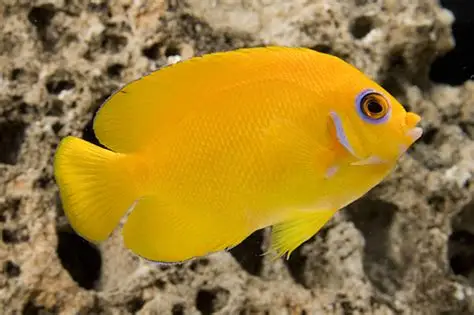
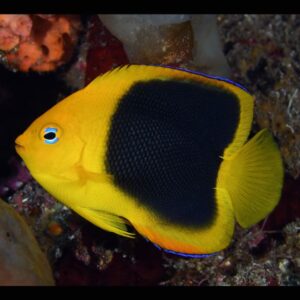
The Lemonpeel Angelfish (Centropyge flavissima), also known as the Yellow Angelfish, is a species of marine angelfish belonging to the family Pomacanthidae. It was first formally described in 1831 by the French anatomist Georges Cuvier. The specific name flavissima means ‘very yellow,’ referring to its colour. The Lemonpeel Angelfish is bright yellow in colour with a bluish or whitish ring surrounding the eye. There is a black blotch on the rear margin of the gill cover. The spine on the preoperculum is blue, and the dorsal, anal, and caudal fins have blue margins.
Physical Description
Juveniles have an ocellus on the flank that is black with blue edges. The dorsal fin contains 14 spines and 15-16 soft rays while the anal fin has 3 spines and 16 soft rays. This species attains a maximum total length of 14 cm (5.5 in). The Lemonpeel Angelfish
Distribution and Habitat
is found in the Indo-Pacific. Its core distribution is in the Central Pacific from the Ryukyu Islands and Ogasawara Islands of southern Japan east to the Tuamotu Islands and south to Australia. It is found in shallow water, typically shallower than 20 meters, in coral-rich areas in lagoons and seaward reefs. Juveniles are more secretive than the adults.
Behavior and Reproduction
They are normally encountered in small groups, a harem of a single male and several females. This species is a protogynous hermaphrodite. It
Diet and Feeding
feeds mainly on filamentous algae.
Aquarium Care
In captivity, the Lemonpeel Angelfish requires a tank of at least 30 gallons with abundant live rock for grazing. It needs to be slowly acclimated and fed several times per day. It accepts mysis shrimp, brine shrimp, and algae. While generally considered more reef-safe than larger angelfish species, individual specimens may occasionally nip at corals.
Conservation Status
Classified as Least Concern by the IUCN Red List.
Reviews
There are no reviews yet.