
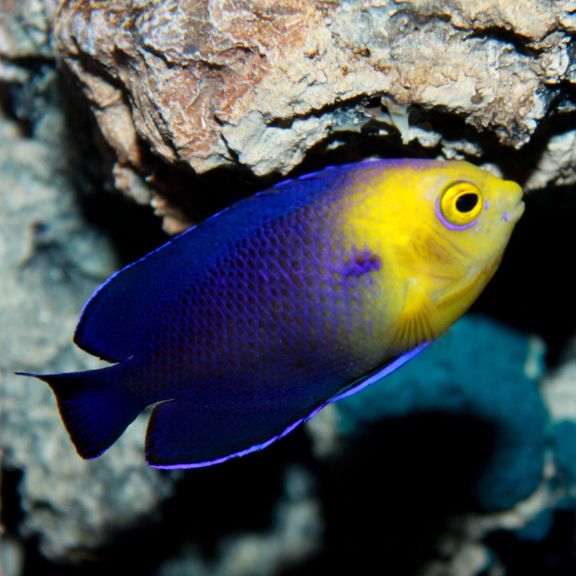
| Parameter | Value |
|---|---|
| Diet | Omnivore |
| dKH | 8-12 |
| Maximum Size | 8 cm (3.1 in) |
| Minimum Tank Size | 20 gallons (76 L) |
| pH | 8.1-8.4 |
| Temperament | Semi-aggressive |
| Temperature | 72-82 F (22-28 C) |
| Weight | Approximately 20 g (0.7 oz) at maximum size |
The Pygmy Angelfish (Centropyge argi), also known as the Cherubfish, is a species of marine angelfish belonging to the family Pomacanthidae. It was first formally described in 1951 by Loren Paul Woods and Robert H. Kanazawa. The Pygmy Angelfish
Physical Description
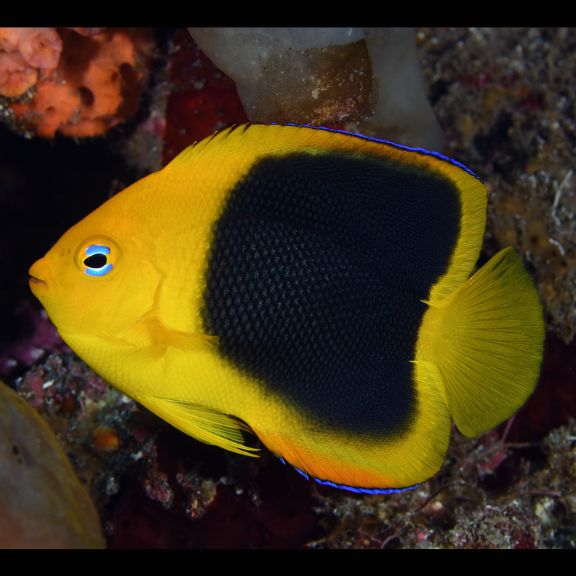
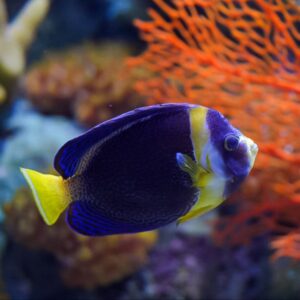
has an oval, deep and laterally compressed body with a short, blunt snout and a small mouth. There is a long, robust spine at the angle of the preoperculum. The body is deep blue in colour with the head and chest being orange-yellow with a thin blue eye ring and a small dark blue blotch to the rear of the mouth. The pectoral fins are pale yellowish while the other fins are dark blue with light blue margins. The dorsal fin contains 14-15 spines and 15-16 soft rays while the anal fin has 3 spines and 17 soft rays. This species attains a maximum total length of 8 cm (3.1 in). The Pygmy Angelfish
Distribution and Habitat
is found in the western Atlantic Ocean. It occurs off Bermuda and from North Carolina through the Caribbean Sea and Gulf of Mexico to the Caribbean coast of South America, as far east as French Guiana. It occurs at depths between 5 and 18 meters, typically below 30 meters. Its usual habitat is coral rubble where it
Diet and Feeding
feeds on algae and small benthic invertebrates. It retreats into cavities when alarmed. It lives in small groups of around 10 fish, usually a single male and a few females and juveniles. The Pygmy Angelfish
Aquarium Care
is one of the most popular species of marine angelfish in aquaria. It requires a tank of at least 20 gallons with abundant live rock for grazing and hiding. It is semi-aggressive and may display territorial behavior toward other dwarf angelfish. While generally considered more reef-safe than larger angelfish species, individual specimens may occasionally nip at corals.
Conservation Status
Classified as Least Concern by the IUCN Red List.

Reviews
There are no reviews yet.