
| Parameter | Value |
|---|---|
| Diet | Omnivore |
| dKH | 8-12 |
| Maximum Size | 30 cm (12 in) |
| Minimum Tank Size | 100 gallons (379 L) |
| pH | 8.1-8.4 |
| Temperament | Semi-aggressive |
| Temperature | 72-82 F (22-28 C) |
| Weight | Approximately 500 g (1.1 lbs) at maximum size |
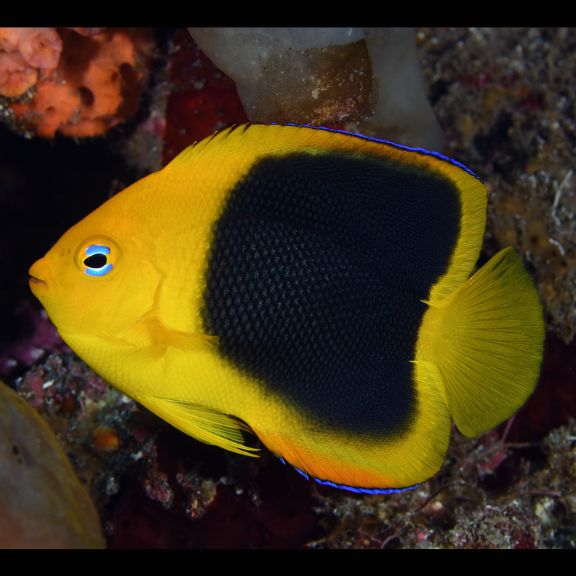
The Rock Beauty (Holacanthus tricolor), also known as Corn Sugar, Coshubba, or Yellow Nanny, is a species of marine angelfish in the family Pomacanthidae. It was first formally described in 1795 by the German physician and naturalist Marcus Elieser Bloch. The specific name tricolor means ‘three-colored,’ referring to the fact that adult rock beauties are predominantly yellow, black, and red. The Rock Beauty
Physical Description
has a deep, oval and strongly compressed body, and attains a maximum total length of 30 cm (12 in). It has a short snout, ending in a small mouth equipped with bristle-like teeth. Juveniles are yellowish on their body and fins, with a blue-margined black spot on the upper posterior part of the body. As they mature, the spot grows, eventually covering most of the body, the lower part of the dorsal fin, and the upper part of the anal fin. The head and the anterior quarter of the body remain yellow, as do the pectoral, pelvic, and caudal fins. The mouth is purple, and the distal edge of the anal fin and the operculum margin are red or orange. The upper and lower portions of the iris are vividly blue. In the dorsal fin there are 14 spines and 17-19 soft rays, while the anal fin has 3 spines and 18-20 soft rays. The Rock Beauty
Distribution and Habitat
is found in the western Atlantic, ranging from Bermuda and the waters off Georgia and Florida through the Caribbean Sea to as far south as Rio de Janeiro. It is found at depths between 3 and 92 meters. Adults occur around jetties, rocky reefs, and coral reefs, while juveniles are often seen in areas of fire coral. Adult rock beauties feed largely on sponges but will also eat corals, zoantharians, bryozoans, gorgonians, tunicates, and algae.
Behavior and Reproduction
They are normally encountered as pairs and appear to form long-term monogamous pairs. Unlike some related species, the Rock Beauty does not act as a cleaner fish.
Aquarium Care
The Rock Beauty requires a tank of at least 100 gallons with stable water conditions. Not considered reef-safe.
Conservation Status
Classified as Least Concern by the IUCN Red List.


Reviews
There are no reviews yet.