
| Parameter | Value |
|---|---|
| Diet | Omnivore |
| dKH | 8-12 |
| Maximum Size | 41 cm (16.2 in) |
| Minimum Tank Size | 180 gallons (681 L) |
| pH | 8.1-8.4 |
| Temperament | Semi-aggressive |
| Temperature | 72-82 F (22-28 C) |
| Weight | Approximately 1,600 g (3.5 lbs) at maximum size |
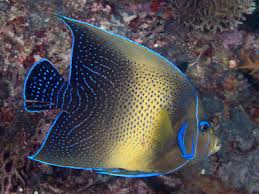
The French Angelfish (Pomacanthus paru) is a slow-growing coral reef fish from the Caribbean belonging to the family Pomacanthidae. It was first formally described in 1787 by the German physician and naturalist Marcus Elieser Bloch. The specific name paru is the Portuguese name for this species. The French Angelfish
Distribution and Habitat
is found in the western Atlantic from Florida and the Gulf of Mexico down to Brazil, including the Caribbean. It occurs at depths from shallow waters close to shore down to about 70 meters. The French Angelfish
Physical Description
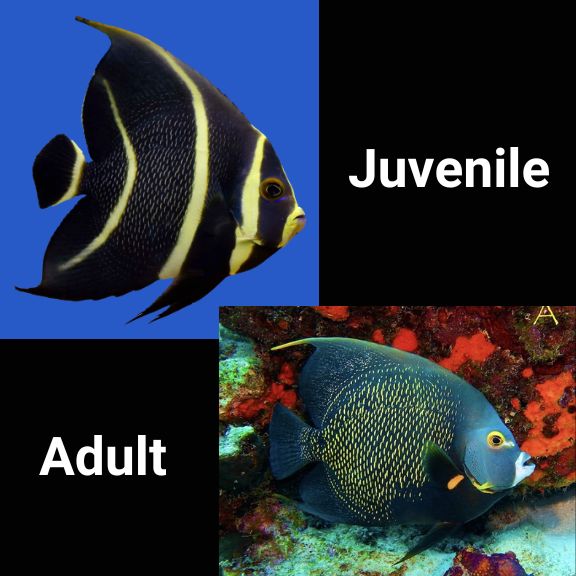
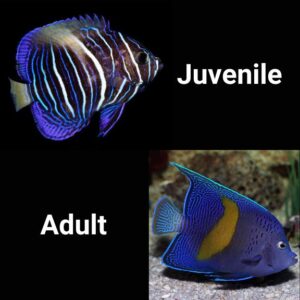
has a deep but vertically compressed body. Both males and females have a black or dark gray body that contrasts with bright yellow tips on their scales. They have a white mouth and a yellow orbit. The pectoral fins have a wide orange-yellow band and the dorsal fin has a long yellow filamentous extension. Juveniles are almost completely black apart from five vertical yellow bands. The dorsal fin contains 10 spines and 29-31 soft rays while the anal fin contains 3 spines and 22-24 soft rays. This species attains a maximum total length of 41.1 cm (16.2 in). French angelfish are common on rocky and coral reefs where
Behavior and Reproduction
they are normally encountered in pairs, frequently in the vicinity of sea fans.
Diet and Feeding
Their diet comprises sponges (approximately 70 percent of their diet), algae, bryozoans, zoantharians, gorgonians, hydroids, coral, and tunicates. Juveniles act as cleaner fish and establish cleaning stations, removing ectoparasites from larger fish species. These pairs are highly territorial. The species forms monogamous pairs and is a protogynous hermaphrodite. The oldest recorded specimen was 27 years old.
Aquarium Care
The French Angelfish requires a large aquarium of at least 180 gallons with stable water conditions and abundant live rock. Not considered reef-safe.
Conservation Status
Classified as Least Concern by the IUCN Red List.
Reviews
There are no reviews yet.