
| Parameter | Value |
|---|---|
| Diet | Carnivore |
| dKH | 8-12 |
| Maximum Size | 8 cm (3.1 in) |
| Minimum Tank Size | 30 gallons (114 L) |
| pH | 8.1-8.4 |
| Temperament | Peaceful |
| Temperature | 72-82 F (22-28 C) |
| Weight | Approximately 10 g (0.4 oz) |
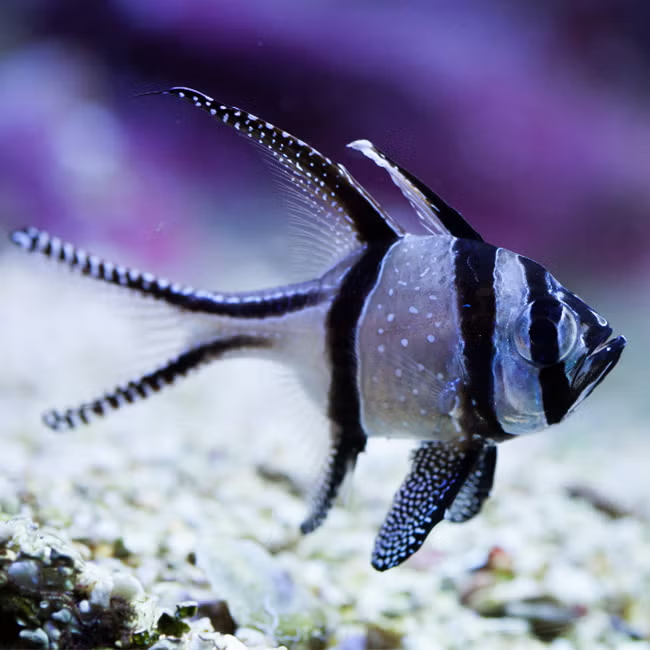
The Banggai Cardinalfish (Pterapogon kauderni) is a small tropical cardinalfish in the family Apogonidae. It is the only member of its genus. This species is restricted to the Banggai Islands of Indonesia.
Distribution and Habitat
The Banggai Cardinalfish is restricted to the Banggai Islands of Indonesia with an extremely limited geographic range. A small population also occurs off Central Sulawesi. It inhabits shallow waters including coral reefs, seagrass beds, and open areas of sand and rubble at depths of 1.5 to 2.5 meters.
Physical Description
The Banggai Cardinalfish grows up to 8 cm (3.1 in) total length. It is easily differentiated from all other cardinalfishes by its tasseled first dorsal fin, elongated anal and second dorsal fin rays, deeply forked caudal fin, and color pattern consisting of three black bars across the head and body and prominent black anterior edges on the anal and second dorsal fin.
Diet and Feeding
The Banggai Cardinalfish is an opportunistic feeder. Its diet includes planktonic, demersal, and benthic organisms. Copepods constitute the bulk of its diet. In captivity it accepts a varied diet including mysis shrimp, brine shrimp, and frozen preparations.
Behavior and Reproduction
The Banggai Cardinalfish is a paternal mouthbrooder. The female plays an active role in courtship and pair formation. The eggs are about 2.5 mm in diameter. The young remain in the male’s mouth cavity after hatching. Unlike many other marine fish, this species lacks a planktonic larval stage.
Aquarium Care
This species is peaceful and can be kept in groups. It requires a tank of at least 30 gallons with abundant live rock. It is considered reef-safe.
Conservation Status
Classified as Endangered by the IUCN Red List due to its small range and exploitation for the aquarium trade. Captive-bred specimens are available and recommended.
Reviews
There are no reviews yet.