
| Parameter | Value |
|---|---|
| Diet | Omnivore |
| dKH | 8-12 |
| Maximum Size | 50 cm (19.7 in) |
| Minimum Tank Size | 150 gallons (568 L) |
| pH | 8.1-8.4 |
| Temperament | Peaceful |
| Temperature | 72-82 F (22-28 C) |
| Weight | Approximately 2,000 g (4.4 lbs) at maximum size |
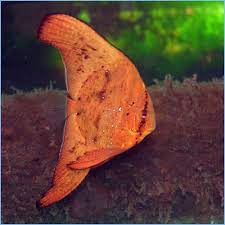
The Orbiculate Batfish (Platax orbicularis), also known as the Circular Batfish, Round Batfish, or Orbic Batfish, is a species of marine ray-finned fish belonging to the family Ephippidae, the spadefishes and batfishes.
Distribution and Habitat
The Orbiculate Batfish is native to the Indo-Pacific from eastern Africa from South Africa, Madagascar, the Mascarenes and Seychelles, north into the Red Sea east through the Persian Gulf and on into Micronesia as far as the Tuamotu Archipelago, north to southern Japan and south to northern Australia. They are found in shallow protected coastal waters including mangroves, coral reefs and deeper areas with silt substrates. Juveniles typically hide among mangroves and in protected lagoons, frequently amongst flotsam where they mimic dead leaves floating in the water column.
Physical Description
Orbiculate Batfish adults have orbicular or round bodies. The body is very deep and highly compressed. In larger adults with a total length in excess of 40 cm there is an indented snout with a bony intraorbital protuberance. There are five pores on each side of the lower jaw. This species can reach a maximum total length of approximately 50 cm (19.7 in).
Diet and Feeding
The Orbiculate Batfish is omnivorous feeding on algae, small fishes and invertebrates. In captivity it accepts a varied diet including mysis shrimp, brine shrimp, marine algae, and frozen preparations.
Behavior and Reproduction
Orbiculate Batfish adults may be found singly, in small schools, or occasionally in large aggregations. Juveniles are either solitary or in small groups. They lay pelagic eggs and females attain sexual maturity at a length of around 32 cm (13 in).
Aquarium Care
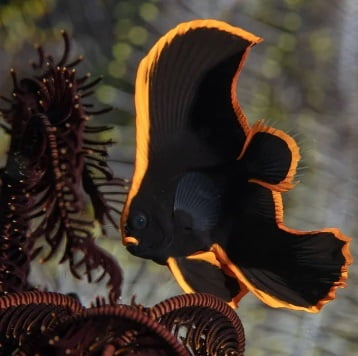
The Orbiculate Batfish requires a large tank of at least 150 gallons due to its adult size. It is generally peaceful and can be kept with a variety of tankmates. It is not considered reef-safe as it may nip at corals and small invertebrates. Juveniles look very different from adults with their round body and leaf-mimicking behavior.
Conservation Status
Classified as Least Concern by the IUCN Red List.
Reviews
There are no reviews yet.